



Choosing between a fixed-roof tank and a floating roof storage tank depends on more than tank size or initial cost. Product characteristics, vapor behavior, operating temperature, emissions, safety requirements, maintenance, and applicable standards all affect the final decision. IESCON helps industrial project teams evaluate these conditions and select storage tank solutions that match the service requirements and project objectives.
What Are Fixed-Roof and Floating-Roof Storage Tanks?
A fixed-roof storage tank has a permanent roof attached to the tank shell. Common roof configurations include cone, dome, and umbrella roofs. The vapor space remains above the stored liquid, so the tank requires appropriate venting and pressure-relief arrangements.
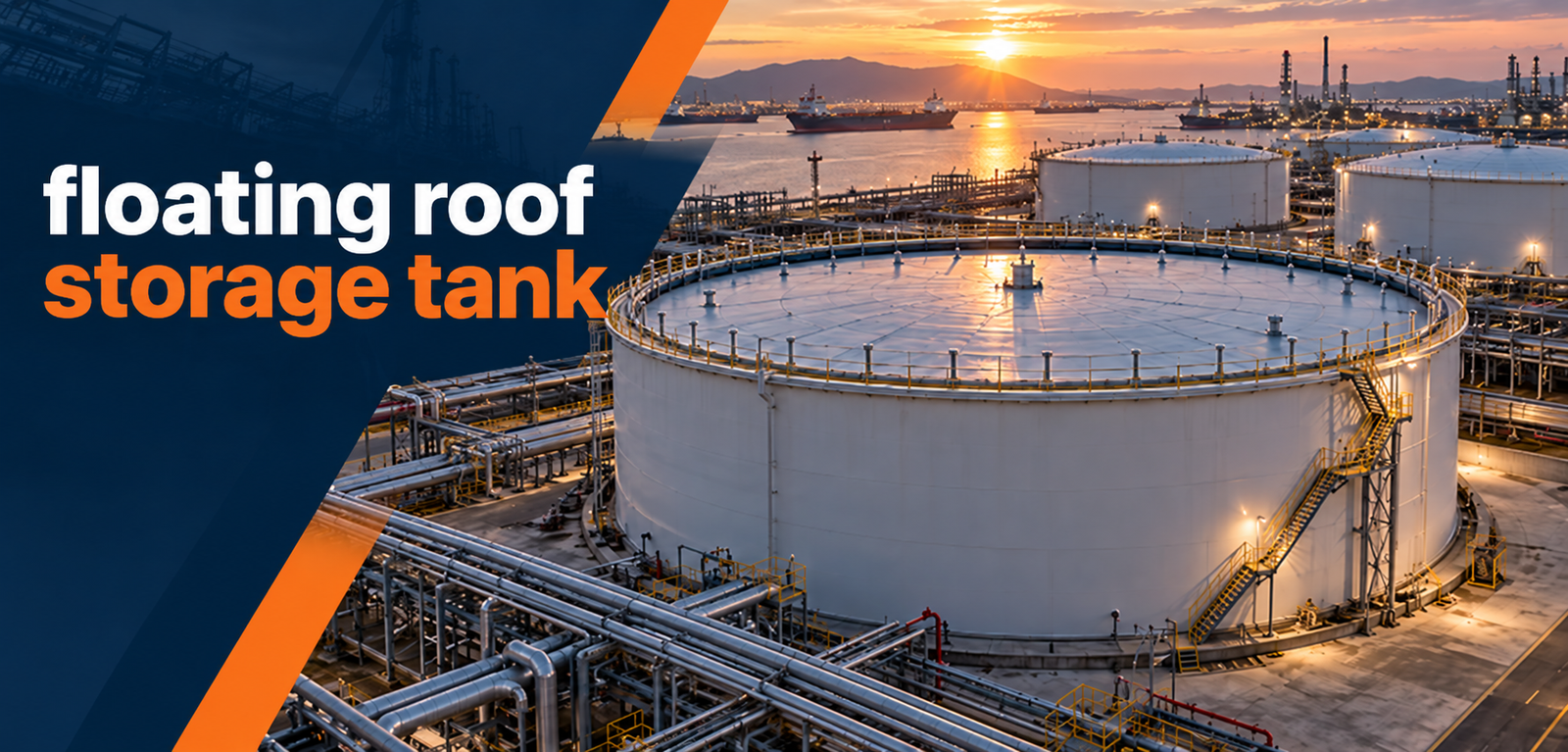
A floating roof storage tank uses a roof that rests directly on the liquid surface or moves with the liquid level. As the product level rises or falls, the roof moves vertically inside or outside the tank shell.
The two main floating roof configurations are:
- External floating roof: The roof is exposed to the atmosphere and floats directly on the stored product.
- Internal floating roof: A floating roof is installed inside a tank that also has a fixed outer roof.
The basic distinction is simple: a fixed roof creates a permanent vapor space, while a floating roof is designed to minimize the vapor space above the liquid.
Fixed-Roof vs Floating-Roof Storage Tanks: Key Differences
The correct choice depends on the service rather than a universal preference.
| Factor | Fixed-Roof Tank | Floating Roof Storage Tank |
| Roof position | Permanently attached | Moves with liquid level |
| Vapor space | Normally present | Significantly reduced |
| Vapor-loss control | Depends heavily on venting and vapor-control systems | Floating roof and seals reduce exposed vapor space |
| Typical application | Water, low-volatility liquids, many process fluids | Volatile petroleum products and hydrocarbon storage |
| Roof exposure | Fixed roof provides enclosure | External floating roof is exposed to weather |
| Maintenance | Generally simpler roof arrangement | Requires attention to seals, roof components, drains, and movement |
| Weather considerations | Roof structure must handle environmental loads | External roof must account for wind, rain, drainage, and other conditions |
| Selection priority | Product, pressure, temperature, and structural requirements | Product volatility, emissions, operating conditions, and safety |
API 650 covers welded aboveground storage tanks for suitable atmospheric and low-pressure services and includes requirements applicable to fixed and floating roof configurations. The current API standards plan lists API 650, 14th Edition, published in August 2025.
How Does a Floating Roof Storage Tank Work?
A floating roof storage tank is designed so that the roof moves with the liquid level.
When the tank is filled, the roof rises. When product is withdrawn, the roof moves downward. This arrangement minimizes the vapor space between the stored liquid and the roof.
The main operating components may include:
- Floating roof structure – supports the roof and allows it to move vertically.
- Roof seals – help reduce vapor release around the shell-to-roof interface.
- Guide system – controls roof movement and helps maintain alignment.
- Roof drains – particularly important for external floating roofs to remove accumulated rainwater.
- Legs and supports – support the roof when the tank is at low liquid levels or out of service.
- Access and safety equipment – provides safe access for inspection and maintenance.
The effectiveness of the system depends on correct design, installation, inspection, and maintenance of the roof and sealing components.
When Is a Fixed-Roof Storage Tank the Better Choice?
A fixed-roof tank may be appropriate when the stored product has relatively low volatility or when the process does not require a floating roof.
Typical considerations include:
- Water and many aqueous products.
- Products with relatively low vapor pressure.
- Applications where a closed tank environment is required.
- Projects where a simple roof arrangement meets the process requirements.
- Services where emissions from vapor space can be adequately controlled through suitable venting or vapor-management systems.
A fixed roof can also provide a practical solution where the product, operating conditions, and applicable regulations do not justify the additional complexity of a floating roof.
However, product vapor characteristics should always be evaluated before selecting a fixed roof for hydrocarbon or volatile-liquid service.
When Is a Floating-Roof Storage Tank the Better Choice?
A floating roof storage tank becomes particularly relevant when reducing the vapor space above a liquid is an important project objective.
It can be considered for products where vapor losses and emissions are significant concerns, especially certain petroleum and hydrocarbon services.
The decision should consider:
- Product volatility.
- Vapor pressure.
- Storage temperature.
- Expected liquid-level changes.
- Environmental requirements.
- Emission-control objectives.
- Tank diameter and capacity.
- Operating frequency.
- Inspection and maintenance requirements.
A floating roof does not eliminate every emission or safety concern. Seal condition, roof movement, fittings, weather exposure, operating practices, and maintenance all affect actual performance.
How Do Stored Product and Vapor Properties Affect Tank Selection?
The stored product is one of the most important inputs in tank selection.
Engineers should review parameters such as:
- Vapor pressure.
- Flash point.
- Boiling range.
- Storage temperature.
- Density.
- Corrosiveness.
- Chemical compatibility.
- Product volatility.
- Required storage capacity.
- Expected filling and withdrawal rates.
For example, storing a low-volatility liquid may not require the same vapor-control approach as storing a volatile hydrocarbon.
Practical Example
Consider two tanks with similar capacity.
Tank A stores water at approximately ambient conditions. A fixed-roof configuration may satisfy the service requirements.
Tank B stores a volatile petroleum product with frequent level changes. Vapor-space management becomes much more important, so a floating roof storage tank may receive stronger consideration.
The tank diameter alone does not determine the answer. The stored product and operating conditions drive the engineering decision.
How Do Operating Conditions Affect the Choice of Storage Tank Roof?
Operating conditions can significantly change the design requirements.
Project teams should evaluate:
- Minimum and maximum liquid levels.
- Filling and emptying frequency.
- Maximum and minimum operating temperatures.
- Wind conditions.
- Rainfall.
- Snow or environmental loads where applicable.
- Corrosion environment.
- Tank location.
- Seismic requirements.
- Product turnover rate.
- Inspection and cleaning requirements.
For external floating roofs, environmental exposure is particularly important because the roof is exposed to weather.
For fixed roofs, structural design, venting, pressure relief, roof loading, and vapor management require careful evaluation.
The selected roof should therefore be treated as part of the complete tank system rather than as an isolated mechanical component.
Fixed-Roof vs Floating-Roof Tanks: Safety and Emissions Considerations
Safety and emissions should be evaluated together with design and operating requirements.
A fixed-roof tank contains a vapor space above the liquid. Depending on the product, this space may contain flammable or hazardous vapors. Proper venting, pressure relief, ignition control, grounding, and operating procedures are therefore important.
A floating roof storage tank reduces the normal vapor space, but introduces additional components that require inspection and safe access.
OSHA identifies storage tanks as potentially hazardous work environments because they may contain flammable liquids, toxic substances, and oxygen-deficient atmospheres. OSHA also addresses hazards associated with access to and work on floating roofs.
API also maintains specific recommended practices addressing safe access and egress involving floating roofs in petroleum service.
The practical lesson is clear: a floating roof is not simply an emissions solution. It is a complete operating system that requires appropriate safety procedures, inspection, and maintenance.
Fixed-Roof vs Floating-Roof Tanks: Cost and Maintenance
Initial cost should not be the only financial consideration.
A fixed-roof tank may have a simpler roof arrangement, but the total project cost can be affected by vapor-control requirements, venting, emissions management, and other equipment.
A floating roof may require additional components such as:
- Sealing systems.
- Roof drainage arrangements.
- Guide components.
- Floating roof supports.
- Special inspection requirements.
- Additional maintenance activities.
The lifecycle comparison should therefore consider both capital expenditure and operating expenditure.
| Cost Consideration | Fixed Roof | Floating Roof |
| Initial roof complexity | Generally lower | Generally higher |
| Vapor-control requirements | May require additional systems | Reduced vapor space helps control losses |
| Seal maintenance | Limited roof-to-shell seal arrangement | Important maintenance activity |
| Drainage | Conventional roof drainage | Important for external floating roofs |
| Inspection | Required | Required, with additional floating-roof components |
| Lifecycle evaluation | Product/service dependent | Product/service dependent |
The most economical solution is the one that satisfies technical, safety, environmental, and operational requirements over the tank’s service life—not necessarily the one with the lowest initial fabrication price.
How Do API Standards Affect Storage Tank Selection?
Applicable standards should be identified during the engineering stage rather than after the tank configuration has already been selected.
API 650 establishes requirements for material, design, fabrication, erection, and inspection of applicable welded aboveground storage tanks. Its scope includes vertical cylindrical tanks operating at pressures approximating atmospheric pressure, subject to the standard’s service limitations.
API’s Aboveground Storage Tanks subcommittee covers standards and recommended practices related to tank design, construction, inspection, repair, cathodic protection, floating roofs, and safe access.
Other standards or regulations may also apply depending on the service, location, product, and project specifications.
Therefore, the project team should establish the applicable code and regulatory basis before finalizing the tank roof type.
What Project Conditions Should Be Evaluated Before Choosing a Tank Type?
A structured evaluation helps avoid costly redesign.
| Project Input | Key Question |
| Product | What exactly will be stored? |
| Vapor properties | How volatile is the product? |
| Temperature | What are minimum and maximum operating temperatures? |
| Capacity | What working and gross capacity is required? |
| Turnover | How frequently is the tank filled and emptied? |
| Emissions | What vapor-loss requirements apply? |
| Location | What environmental conditions affect the tank? |
| Standards | Which API, regulatory, and project specifications apply? |
| Safety | What fire, vapor, access, and emergency requirements apply? |
| Maintenance | What inspection and maintenance program is expected? |
| Lifecycle cost | What are the capital and operating costs? |
| Future expansion | Could the storage service change later? |
How to Choose the Right Storage Tank for Your Project
A practical selection process can be divided into seven steps:
1. Define the Stored Product
Document product composition, volatility, density, vapor pressure, flash point, and compatibility requirements.
2. Establish Operating Conditions
Define temperature, pressure, filling rate, withdrawal rate, minimum level, maximum level, and expected operating cycles.
3. Evaluate Vapor and Emission Requirements
Determine whether vapor losses are a major concern and identify applicable environmental and process requirements.
4. Identify the Applicable Standards
Confirm the relevant API standards, local regulations, client specifications, and project engineering requirements.
5. Compare Fixed and Floating Roof Options
Evaluate technical suitability, safety, emissions, maintenance, capital cost, and lifecycle cost.
6. Review Constructability and Maintenance
Consider fabrication, erection, inspection access, roof components, drainage, corrosion protection, and future maintenance.
7. Document the Engineering Decision
The final tank selection should be supported by a documented technical basis rather than cost alone.
Decision Guide
Choose a fixed roof when:
The product and operating conditions allow a permanent roof and the vapor-management requirements can be adequately addressed.
Consider a floating roof when:
Product volatility, vapor-space reduction, emissions control, and operating conditions make a moving roof technically beneficial.
Consider an internal floating roof when:
The project requires a floating roof inside a tank with an external fixed roof, subject to the applicable design basis and service requirements.
FAQs About Fixed-Roof and Floating-Roof Storage Tanks
1. What is a floating roof storage tank?
A floating roof storage tank uses a roof that moves vertically with the liquid level. Its design reduces the vapor space above the stored product and can help control vapor losses in suitable applications.
2. Is a floating roof better than a fixed roof?
Neither roof type is universally better. The appropriate choice depends on product volatility, operating conditions, emissions requirements, safety considerations, applicable standards, maintenance, and lifecycle cost.
3. What products are commonly stored in floating roof tanks?
Floating roofs are commonly considered for suitable petroleum and hydrocarbon storage services where reducing vapor space and controlling evaporative losses are important project considerations.
4. Does API 650 cover floating roof tanks?
Yes. API 650 is a major standard for applicable welded aboveground storage tanks and includes requirements relevant to different tank configurations, including floating-roof arrangements.
5. What should be checked before selecting a tank roof?
Project teams should check the stored product, vapor pressure, temperature, capacity, filling and withdrawal rates, emissions requirements, environmental conditions, safety requirements, applicable standards, maintenance needs, and lifecycle cost.
Conclusion
Selecting between a fixed roof and a floating roof storage tank should begin with the product and operating conditions, not the roof type itself. IESCON can support industrial tank projects through engineering, fabrication, installation, and project-specific technical evaluation, helping clients align tank configuration with applicable standards, safety requirements, and operational objectives.
Need the Right Storage Tank Solution?
Planning a new tank, tank farm, or industrial storage project?
Talk to IESCON to evaluate your storage requirements and develop a tank solution based on product characteristics, operating conditions, applicable standards, and project requirements.