


ASME Pressure Vessels require controlled engineering, qualified fabrication, inspection, testing, and complete documentation. For industrial projects, selecting the right design approach and manufacturing process is essential for vessel integrity and reliable operation. IESCON provides engineering and industrial solutions with a structured approach to pressure vessel work, from technical requirements and fabrication through inspection, testing, and project documentation.
What Are ASME Pressure Vessels?
ASME Pressure Vessels are pressure-containing vessels designed and manufactured according to applicable requirements of the ASME Boiler and Pressure Vessel Code (BPVC).
ASME Section VIII covers pressure vessels, including requirements related to design, materials, fabrication, inspection, testing, and certification. Division 1 addresses pressure vessels operating at internal or external pressures exceeding 15 psig within its scope.
Typical applications include:
- Oil and gas processing facilities
- Petrochemical plants
- Chemical processing
- Refineries
- Power and industrial plants
- Compressed air systems
- Separators
- Receivers
- Heat-related process equipment
- Process storage and containment systems
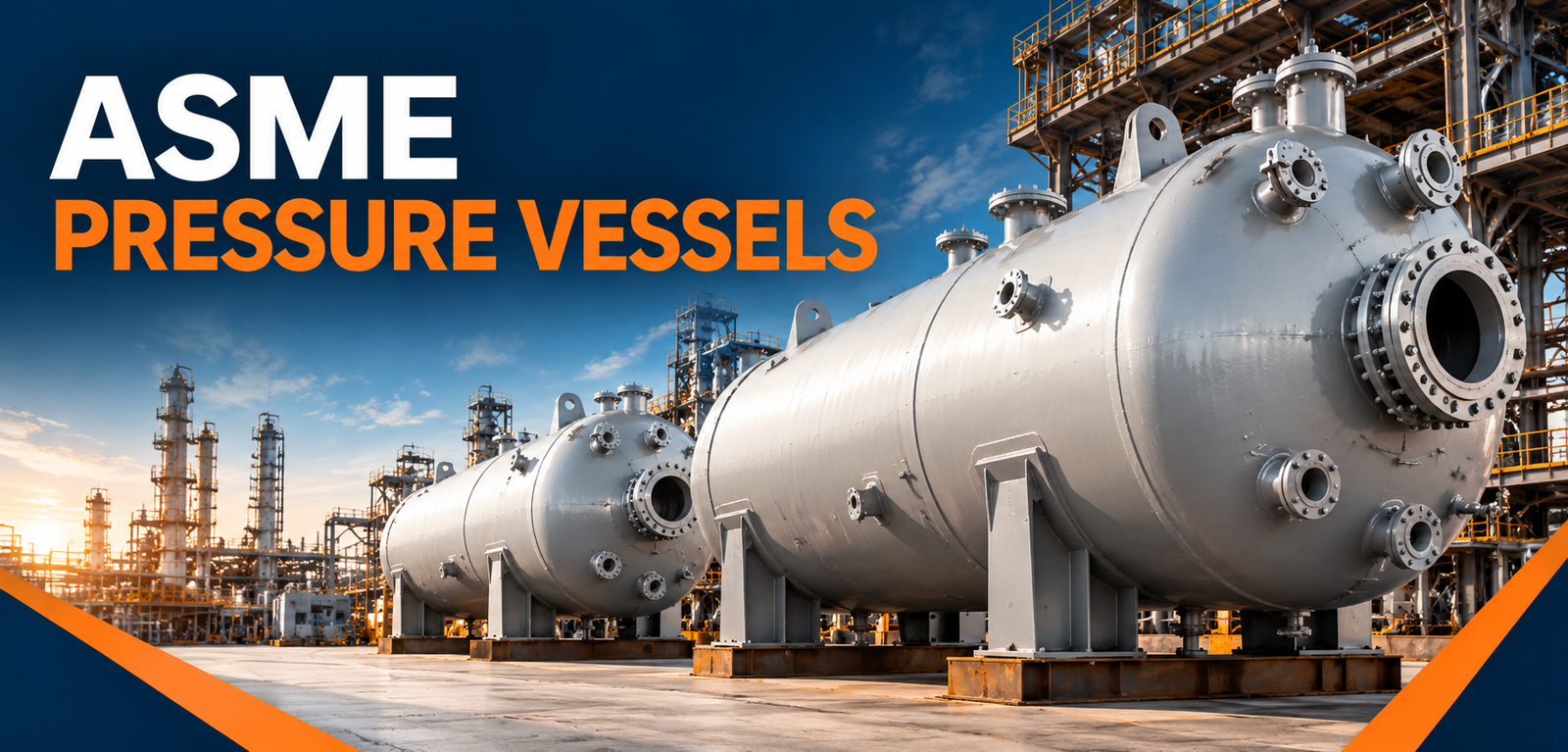
A pressure vessel may be vertical or horizontal, depending on the process requirements, available space, fluid characteristics, and equipment configuration.
The important point is that an ASME pressure vessel is not defined only by its shape. Its design and construction must satisfy the applicable code requirements and project specifications.
ASME Pressure Vessel Design Requirements
Pressure vessel design starts with defining the conditions under which the equipment will operate.
Important design inputs include:
| Design Parameter | Why It Matters |
| Design pressure | Determines required pressure resistance |
| Operating pressure | Defines normal operating conditions |
| Design temperature | Influences material and thickness selection |
| Operating temperature | Defines normal service conditions |
| Fluid properties | Affect material compatibility and safety |
| Corrosion allowance | Accounts for anticipated material loss |
| Vessel volume | Influences geometry and configuration |
| Material specification | Establishes allowable construction materials |
| External loads | Covers applicable piping, wind, seismic, and support loads |
| Nozzle loads | Helps evaluate local stresses and connections |
| Vessel orientation | Determines supports and arrangement |
| Testing requirements | Establishes final verification requirements |
ASME Section VIII design work can involve calculations for shells, heads, openings, nozzle reinforcement, supports, pressure loads, and other applicable conditions.
For more complex applications, additional analysis may be required. ASME’s materials describe Section VIII Division 2 as an alternative set of rules with more rigorous requirements for areas such as design, materials, nondestructive examination, and analysis.
Materials and Components for ASME Pressure Vessels
Material selection is a critical part of pressure vessel engineering. The material must satisfy the design conditions and the applicable ASME requirements.
Common materials may include:
- Carbon steel
- Stainless steel
- Low-alloy steel
- High-alloy materials
- Other code-permitted materials depending on the application
Typical vessel components include:
- Cylindrical shell
- Elliptical or hemispherical heads
- Nozzles
- Manways
- Flanges
- Reinforcement pads
- Supports
- Skirts
- Saddles
- Lifting lugs
- Internal components
- Drain connections
- Vent connections
- Pressure relief connections
ASME’s certification requirements identify Section II as the material reference within the certification framework, including specifications for ferrous and nonferrous materials, welding consumables, and material properties.
Material traceability should be maintained from receiving through fabrication and final documentation.
ASME Pressure Vessel Fabrication Process
A controlled ASME Pressure Vessel Fabrication process normally follows a defined sequence.
1. Engineering Review
The approved drawings, design calculations, specifications, material requirements, welding requirements, and inspection plan are reviewed before fabrication.
2. Material Procurement and Verification
Materials are received and checked against the required specifications. Material certificates and identification records are maintained.
3. Cutting and Forming
Plates are cut according to approved drawings and formed into shells, heads, or other required components.
4. Fit-Up
Components are aligned and prepared for welding. Dimensional checks help prevent problems during assembly.
5. Welding
Qualified welding procedures and qualified personnel are used according to the applicable code and project requirements.
6. Heat Treatment
Post-weld heat treatment may be required depending on material, thickness, design conditions, and applicable code requirements.
7. Nondestructive Examination
Applicable NDE methods are performed according to the inspection plan and governing requirements.
8. Pressure Testing
The completed vessel is tested using the applicable pressure-test method and acceptance criteria.
9. Final Inspection
Final dimensional checks, documentation review, marking, and inspection activities are completed before release.
This sequence creates a traceable path from raw material to completed pressure equipment.
Welding Requirements for ASME Pressure Vessels
Welding is one of the most important activities in pressure vessel manufacturing because weld quality directly affects pressure boundary integrity.
A welding control system may include:
- Welding Procedure Specifications (WPS)
- Procedure Qualification Records (PQR)
- Welder performance qualifications
- Welding consumable control
- Preheat requirements
- Interpass temperature control
- Weld identification
- Visual inspection
- Nondestructive examination
- Weld repair procedures
- Post-weld heat treatment where required
ASME Section IX provides qualification requirements for welding, brazing, and fusing procedures and personnel. ASME’s Section VIII training materials also identify welded-joint design, PWHT, NDE, testing, and documentation as important areas of pressure vessel construction.
Why Welding Control Matters
Consider a vessel with several shell-to-head and nozzle welds. A defect discovered after final assembly can require additional examination, repair, and retesting.
Early fit-up and weld inspection can identify problems before they affect later fabrication stages.
Inspection and Testing of ASME Pressure Vessels
Inspection verifies whether fabrication meets the approved design and applicable code requirements.
Depending on the vessel and project specification, inspection may include:
| Inspection / Test | Main Purpose |
| Material inspection | Confirms material identity and compliance |
| Dimensional inspection | Verifies geometry and tolerances |
| Visual inspection | Detects visible fabrication defects |
| Radiographic examination | Examines applicable weld areas |
| Ultrasonic examination | Detects internal discontinuities |
| Magnetic particle examination | Detects relevant surface/near-surface indications |
| Liquid penetrant examination | Detects surface-breaking indications |
| Hydrostatic testing | Verifies pressure boundary integrity |
| Pneumatic testing | Used where permitted and specified |
| Final inspection | Confirms completion and documentation |
The exact examination method, extent, acceptance criteria, and pressure-test requirements depend on the applicable ASME division, vessel design, materials, project specification, and governing requirements.
ASME’s Section VIII material specifically identifies NDE, pressure testing, pressure relief, stamping, and manufacturer’s data reports as key elements of pressure vessel construction.
ASME Pressure Vessel Codes and Standards
The term ASME Pressure Vessels can involve several sections of the BPVC rather than one document alone.
| ASME Section | Relevance |
| Section II | Materials |
| Section V | Nondestructive Examination |
| Section VIII | Pressure Vessels |
| Section IX | Welding, Brazing, and Fusing Qualifications |
| Section XIII | Overpressure Protection |
The applicable requirements should always be determined from the vessel’s design, construction category, project specification, and certification scope.
ASME’s current certification information identifies Sections II, V, VIII, and IX among the code books relevant to U and U2 pressure-vessel certification programs.
ASME Section VIII and Pressure Vessel Requirements
ASME Section VIII is the central BPVC section for pressure vessel construction.
It includes different divisions for different design and construction approaches.
Section VIII Division 1
Division 1 provides requirements for the design, fabrication, inspection, testing, and certification of pressure vessels within its scope.
It is commonly considered when designing conventional pressure vessels that fall within its applicable limits.
Section VIII Division 2
Division 2 provides alternative rules and involves more detailed design and analysis requirements. ASME describes Division 2 as having more rigorous requirements in areas including materials, design, and nondestructive examination while permitting higher design stress intensities in applicable cases.
Section VIII Division 3
Division 3 provides alternative rules for the construction of high-pressure vessels.
Division Comparison
| Factor | Division 1 | Division 2 | Division 3 |
| General purpose | Pressure vessels within Div. 1 scope | Alternative rules | High-pressure vessels |
| Design approach | Code-based design rules | More detailed analysis | Specialized high-pressure design |
| Analysis requirements | Defined by code | More rigorous in applicable areas | Specialized requirements |
| Typical selection | Conventional applications | More demanding designs | High-pressure applications |
The correct division should be selected by qualified engineering professionals based on actual service conditions and applicable project requirements.
Documentation and Certification for ASME Pressure Vessels
Documentation is an essential part of an ASME Pressure Vessel project.
A project documentation package may include:
- Approved design drawings
- Design calculations
- Material certificates
- Material traceability records
- Welding procedures
- Welder qualifications
- Welding records
- NDE reports
- Heat-treatment records where applicable
- Dimensional inspection reports
- Pressure-test records
- Calibration records
- Coating records where applicable
- Inspection reports
- Manufacturer’s Data Report
- Applicable certification documentation
ASME states that its Certification Mark is associated with equipment certified to applicable BPVC requirements, and its conformity-assessment process includes requirements for certification and code stamping.
An important distinction is that simply saying a vessel is “ASME designed” does not automatically mean that it carries an ASME Certification Mark. Certification and stamping depend on the applicable ASME conformity-assessment requirements and the manufacturer’s authorized scope.
Safety and Quality Control in Pressure Vessel Manufacturing
Pressure vessel manufacturing requires both technical quality control and a strong safety system.
Key controls include:
- Approved engineering documents.
- Material identification and traceability.
- Controlled welding activities.
- Qualified personnel.
- Inspection hold points.
- NDE according to the inspection plan.
- Controlled heat treatment where applicable.
- Calibrated inspection equipment.
- Pressure-testing controls.
- Complete documentation before final release.
Safety planning should also address lifting operations, hot work, welding fumes, electrical hazards, working at height, confined spaces, pressure testing, and handling of heavy components.
Quality should be controlled throughout manufacturing rather than being treated as a final inspection activity.
How to Choose an ASME Pressure Vessel Manufacturer
Choosing an ASME Pressure Vessel Manufacturer requires more than comparing prices.
Evaluate the manufacturer based on:
- Relevant pressure vessel experience
- Engineering capability
- Applicable ASME certification scope
- Qualified welding procedures
- Qualified welding personnel
- Material traceability
- NDE capabilities
- Quality control procedures
- Inspection planning
- Fabrication capacity
- Testing facilities
- Documentation system
- HSE management
- Ability to coordinate with the project engineering team
A Simple Contractor Evaluation Checklist
Before awarding the fabrication scope, ask:
Can the manufacturer handle the required vessel design?
Does its certification scope match the required construction?
Can it provide complete material and welding traceability?
Can it perform or coordinate the required NDE?
Can it provide the required pressure testing and documentation?
Can it manage fabrication changes without losing document control?
These questions help the owner evaluate technical suitability before focusing on commercial terms.
Common Challenges in ASME Pressure Vessel Design and Fabrication
Several challenges can affect the cost, schedule, and quality of a pressure vessel project.
Design Changes After Fabrication Starts
Late nozzle changes, material changes, or modifications to operating conditions can require engineering revisions and fabrication rework.
Material Availability
Special materials or specific thicknesses may require longer procurement periods.
Welding and Repair
Welding defects may require repair, additional NDE, and retesting, affecting the production schedule.
Complex Nozzle Configurations
Multiple nozzles and high local loads can make engineering, fabrication, and inspection more demanding.
Documentation Gaps
Missing material certificates, inspection records, welding documentation, or test reports can delay final handover.
Coordination Problems
Pressure vessels often connect to piping and other process equipment. Poor interface management can result in dimensional or installation issues.
Practical Example
Suppose an industrial project requires a horizontal pressure vessel with several process nozzles, a defined operating temperature, corrosion allowance, and specified design pressure.
A reliable workflow would begin by freezing the design basis, confirming materials, approving fabrication drawings and welding procedures, controlling material traceability, inspecting welds progressively, completing pressure testing, and compiling the final documentation package.
This approach reduces the risk of discovering major documentation or fabrication issues at the final inspection stage.
Frequently Asked Questions About ASME Pressure Vessels
1. What is an ASME pressure vessel?
An ASME pressure vessel is pressure-containing equipment constructed according to applicable requirements of the ASME Boiler and Pressure Vessel Code, including relevant rules for design, materials, fabrication, inspection, testing, and certification.
2. Which ASME section is used for pressure vessels?
ASME Section VIII is the primary BPVC section for pressure vessels. It includes Divisions 1, 2, and 3, with different rules and applications depending on vessel design and pressure conditions.
3. What is the difference between ASME Section VIII Division 1 and Division 2?
Division 1 provides established construction rules for pressure vessels within its scope, while Division 2 uses alternative rules with more rigorous design and analysis requirements for applicable vessels.
4. Does every ASME pressure vessel need an ASME Stamp?
Not necessarily. An ASME Certification Mark is associated with equipment constructed under an applicable ASME certification program. The required certification scope and stamping requirements must be established for the specific project.
5. What documents should come with an ASME pressure vessel?
The documentation package can include drawings, calculations, material certificates, welding qualifications, NDE reports, heat-treatment records where applicable, pressure-test records, inspection reports, and the applicable manufacturer’s data and certification documents.
Conclusion
Reliable ASME Pressure Vessels depend on disciplined engineering, material control, qualified welding, inspection, testing, and documentation. IESCON can support industrial projects through a structured approach to pressure vessel engineering and fabrication requirements, helping project teams maintain technical control from design review through final inspection and documentation.
Need Professional ASME Pressure Vessel Support?
Planning an industrial pressure vessel project? Work with a team that understands the importance of engineering accuracy, fabrication control, inspection, and complete documentation.
Contact IESCON today to discuss your ASME pressure vessel requirements and request a project-specific consultation.