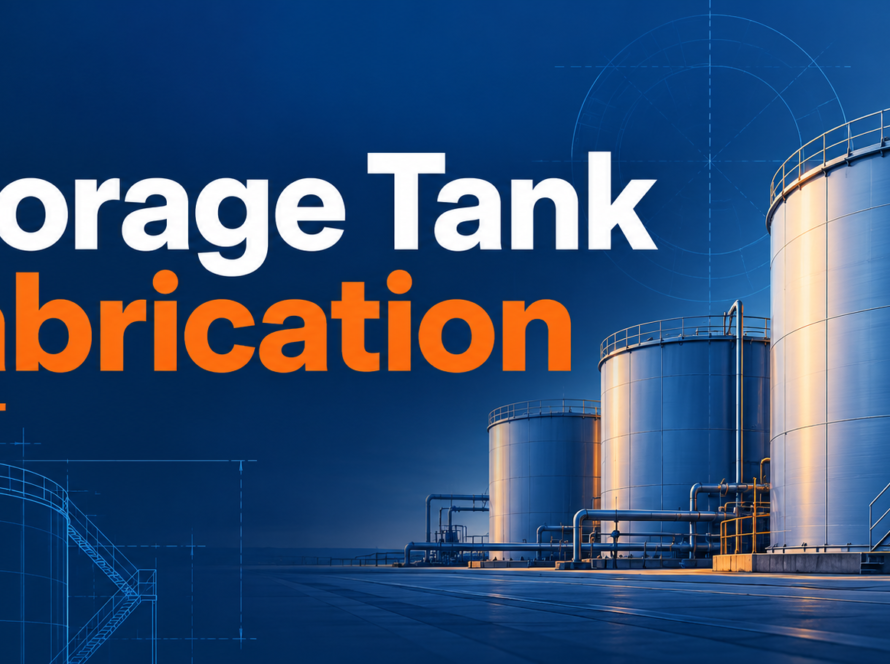



A Tank Farm is more than a group of storage tanks. It is an integrated industrial system where civil, mechanical, piping, electrical, instrumentation, safety, and commissioning activities must work together. IESCON provides engineering and industrial solutions covering tanks, piping, fabrication, and project execution. Understanding these interfaces is essential for controlling cost, quality, schedule, and safe operation.
What Is a Tank Farm?
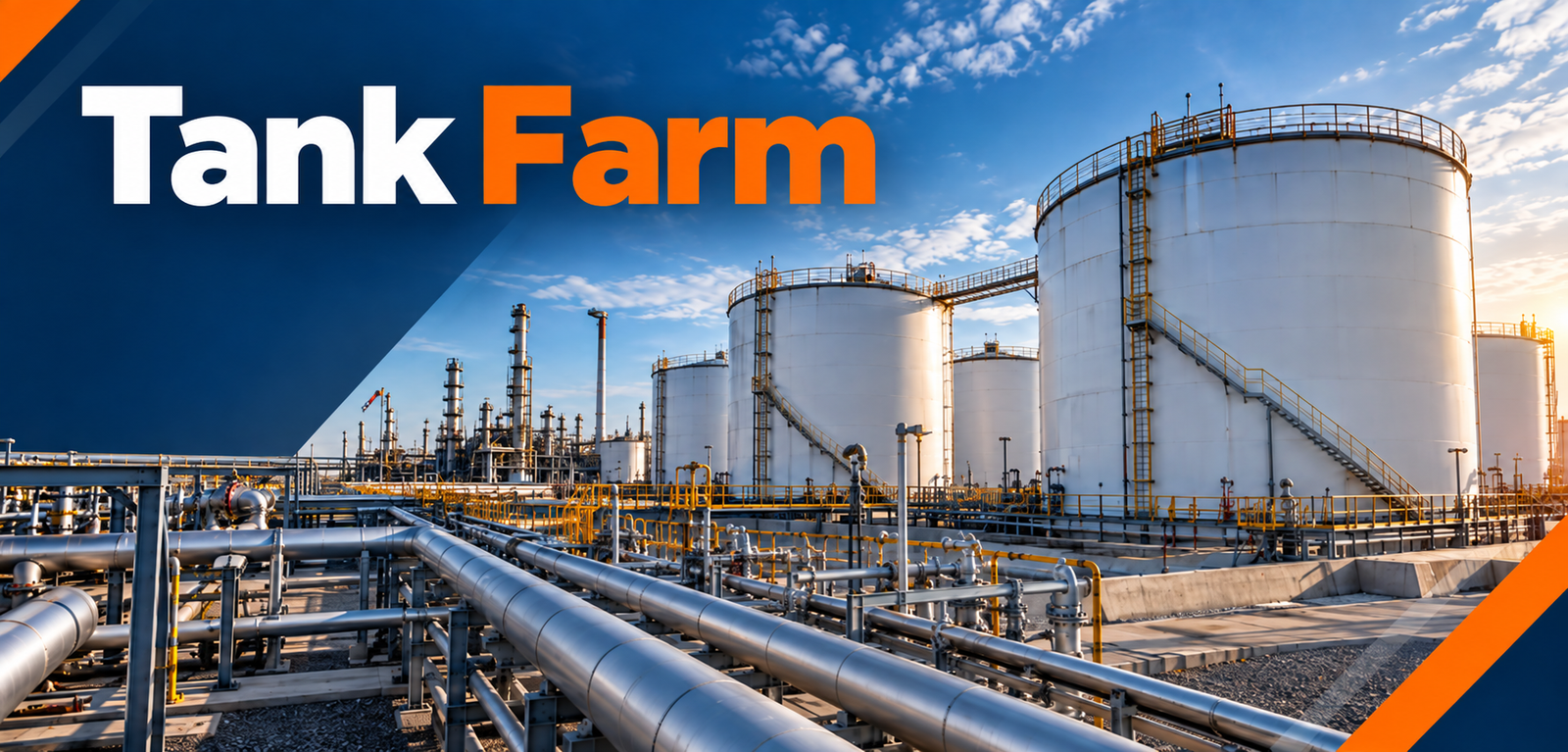
A Tank Farm is a designated industrial area containing storage tanks and the associated systems required to receive, store, transfer, monitor, protect, and distribute liquids or other products.
Depending on the facility, a tank farm may include:
- Storage tanks
- Tank foundations
- Bunds or secondary containment
- Product transfer piping
- Pumps and valves
- Loading and unloading systems
- Electrical power systems
- Instrumentation and control
- Fire protection systems
- Drainage systems
- Access roads and platforms
- Utility connections
- Control and monitoring systems
The exact configuration depends on the stored product, tank type, capacity, operating conditions, applicable regulations, and project requirements.
API maintains standards covering storage tanks and terminal/tank facilities, including API 650 for welded oil storage tanks and API 2610 for terminal and tank facilities.
What Is Included in a Tank Farm EPC Scope?
A Tank Farm EPC scope normally integrates multiple engineering and construction disciplines.
| Discipline | Typical Scope |
| Civil | Foundations, roads, drainage, containment |
| Mechanical | Tanks, pumps, equipment, fabrication |
| Piping | Product, utility, drain, and transfer piping |
| Electrical | Power distribution, lighting, grounding |
| Instrumentation | Measurement, control, alarms |
| HSE | Fire protection and safety systems |
| Commissioning | Testing, flushing, functional checks |
The most important point is that these disciplines cannot be designed or executed independently.
For example, the location of a tank foundation affects tank erection. Tank nozzle locations affect piping. Piping routes affect supports and structures. Instrument connections affect both piping and control systems.
Civil Works in Tank Farm Projects
Civil works create the physical foundation for the entire facility.
Typical civil scope includes:
- Site preparation
- Excavation and grading
- Tank foundations
- Equipment foundations
- Pipe rack foundations
- Bund walls and containment areas
- Roads and access routes
- Drainage networks
- Underground utilities
- Cable trenches
- Concrete structures
- Platforms and equipment supports
Tank Foundations
Tank foundations must be designed according to the tank characteristics, soil conditions, loads, settlement considerations, and applicable engineering requirements.
The civil team must coordinate foundation dimensions and elevations with mechanical and tank design information.
A small interface error can create significant downstream problems.
For example, an incorrect foundation elevation can affect tank nozzle orientation, piping slope, pump suction conditions, and access arrangements.
Mechanical Works in Tank Farm Projects
Mechanical works are usually centered around the storage and product-handling equipment.
Typical mechanical scope may include:
- Storage tank fabrication
- Tank erection
- Roof installation
- Nozzles and manways
- Internal components
- Pumps
- Mechanical equipment
- Valves
- Platforms
- Ladders
- Access structures
- Equipment alignment
- Mechanical testing
For welded atmospheric storage tanks within its scope, API 650 establishes minimum requirements for material, design, fabrication, erection, and inspection.
Mechanical scope should therefore be developed together with engineering, piping, civil, inspection, and commissioning requirements.
Piping Scope and Tank Farm Piping Interfaces
Piping connects the tanks with the rest of the facility.
Depending on the application, a Tank Farm piping system may include:
- Tank inlet lines
- Tank outlet lines
- Transfer lines
- Pump suction and discharge piping
- Recirculation lines
- Drain systems
- Overflow or vent-related connections
- Utility piping
- Firewater piping
- Sampling connections
- Loading and unloading connections
Critical Piping Interfaces
The piping engineer must coordinate with:
Tank → Nozzle → Valve → Piping → Pump → Equipment → Instrumentation
The location, orientation, size, and elevation of tank nozzles are particularly important because they influence piping flexibility, supports, access, maintenance, and equipment connections.
Piping support locations must also be coordinated with civil structures and pipe racks.
Practical Example
Illustrative example: If a tank outlet nozzle is relocated after the piping layout has been finalized, the change may affect the pipe route, support locations, valve accessibility, stress analysis, material quantities, and construction sequence.
This demonstrates why interface control should begin during engineering rather than during construction.
Electrical Scope in Tank Farm Projects
Electrical systems provide power and operational support throughout the facility.
Typical electrical scope includes:
- Incoming power
- Distribution panels
- Transformers
- Motor control systems
- Pump power supplies
- Lighting
- Emergency lighting
- Grounding
- Lightning protection
- Cable trays
- Power and control cables
- Electrical equipment in classified areas
Electrical design must consider the characteristics of the stored product and the hazardous-area requirements applicable to the facility.
API’s standards catalog includes requirements related to electrical installations in petroleum facilities, while project-specific electrical classification requirements must be established during engineering.
Electrical interfaces should also be coordinated with instrumentation because control and monitoring systems often require dedicated power and communication infrastructure.
Instrumentation and Control Systems in Tank Farms
Instrumentation allows operators to monitor and control tank farm operations.
Typical instrumentation may include:
- Level measurement
- Temperature measurement
- Pressure measurement
- Flow measurement
- High-level alarms
- Emergency shutdown functions
- Control valves
- Pressure/vacuum protection devices
- Local indicators
- Control panels
- SCADA or DCS interfaces
Instrumentation design should consider what information operators need to safely monitor storage and transfer operations.
Example Instrument Interface
A typical product transfer sequence may involve:
Tank Level → Level Instrument → Control System → Pump Command → Valve Position → Flow Measurement
If one interface is incorrectly configured, the complete operating sequence may be affected.
This is why instrumentation should be tested as an integrated system rather than only testing individual devices.
Interfaces Between Civil, Mechanical, Piping, Electrical, and Instrumentation
Interface management is one of the most important parts of Tank Farm EPC execution.
| Interface | Example |
| Civil + Mechanical | Tank foundation and tank bottom |
| Civil + Piping | Pipe rack and pipe supports |
| Mechanical + Piping | Tank nozzles and connected lines |
| Piping + Instrumentation | Instruments and process connections |
| Electrical + Instrumentation | Power and signal requirements |
| Mechanical + Electrical | Pump motor and power supply |
| Civil + Electrical | Cable trenches and equipment foundations |
| Piping + Electrical | Earthing and equipment access |
Why Interface Management Matters
A change in one discipline can affect several others.
For example:
Tank nozzle change
→ Piping modification
→ Support modification
→ Civil adjustment
→ Instrument relocation
→ Cable/instrument routing review
→ Updated drawings
→ Possible procurement impact
The earlier the interface is identified, the easier it is to control.
Tank Farm Safety and HSE Requirements
Tank farms can involve significant hazards, particularly where petroleum, petrochemical, or other hazardous products are stored.
OSHA identifies hazards associated with storage tanks including fire and explosion, toxic exposure, oxygen deficiency, falls, electrical hazards, and confined-space risks.
A Tank Farm EPC project should therefore address:
- Hazard identification
- Permit-to-work systems
- Hot-work controls
- Confined-space procedures
- Lockout/tagout
- Fire protection
- Emergency response
- Gas detection where applicable
- Personal protective equipment
- Safe lifting
- Working at height
- Electrical safety
- Environmental controls
OSHA also emphasizes management involvement, worksite hazard analysis, prevention and control measures, and worker training as elements of an effective safety and health program.
Safety requirements should be incorporated into engineering and construction planning from the beginning rather than added after installation.
Inspection, Testing, and Commissioning of Tank Farm Systems
Inspection and testing should cover individual components and complete systems.
Typical activities include:
Storage Tanks
- Material verification
- Welding inspection
- Dimensional checks
- NDT as specified
- Tank testing
- Settlement monitoring where required
- Coating inspection
Piping
- Material verification
- Weld inspection
- NDT
- Pressure testing
- Flushing
- Cleaning
- Line checks
Electrical
- Cable testing
- Grounding checks
- Equipment inspection
- Functional testing
- Motor testing
Instrumentation
- Calibration
- Loop checks
- Alarm testing
- Interlock testing
- Control-system verification
Commissioning
The final stage should verify that systems operate together according to the approved design and operating philosophy.
A commissioning sequence may include:
Mechanical Completion → Inspection → Testing → Punch List → System Handover → Functional Testing → Commissioning → Start-Up
Key Challenges in Tank Farm EPC Projects
Tank farm projects can face several execution challenges.
1. Multiple Discipline Interfaces
A change in one discipline can create consequences elsewhere.
2. Large Quantities of Materials
Tanks, piping, valves, cables, instruments, steel, and civil materials require coordinated procurement.
3. Long-Lead Equipment
Specialized pumps, valves, instruments, and electrical equipment may influence the project schedule.
4. Tight Construction Areas
Large tanks and pipe networks require careful planning of access, lifting, storage, and work fronts.
5. Safety-Critical Activities
Hot work, lifting, confined-space activities, and work around hazardous products require strict controls.
6. Commissioning Complexity
Individual systems may work correctly while their interfaces still require adjustment.
How to Manage Tank Farm EPC Interfaces Effectively
A structured interface management process can reduce rework and schedule risk.
Step 1: Define Responsibilities
Create an interface responsibility matrix identifying who owns each deliverable.
Step 2: Freeze Key Design Inputs
Confirm tank locations, capacities, nozzle schedules, piping routes, equipment data, and major elevations.
Step 3: Establish Interface Drawings
Coordinate:
- Plot plans
- Tank layouts
- Piping layouts
- Equipment layouts
- Cable routing
- Instrument locations
- Structural details
Step 4: Conduct Interdisciplinary Reviews
Engineering teams should review interfaces before releasing construction drawings.
Step 5: Track Changes
Every significant design change should be evaluated for its impact on other disciplines.
Step 6: Verify Before Construction
Field teams should confirm dimensions, elevations, and connection points before permanent installation.
Step 7: Use Integrated Testing
Commissioning teams should test connected systems rather than isolated components only.
Tank Farm EPC Scope Checklist
Use this checklist when developing or reviewing an EPC scope:
| Scope Area | Key Items to Confirm |
| Site | Survey, grading, access |
| Civil | Foundations, roads, drainage |
| Tanks | Design, fabrication, erection |
| Mechanical | Pumps, valves, equipment |
| Piping | Process, transfer, utilities |
| Electrical | Power, lighting, grounding |
| Instrumentation | Level, flow, alarms, control |
| Fire Safety | Firewater and protection systems |
| HSE | Risk assessment and work controls |
| Procurement | Long-lead equipment and materials |
| QA/QC | ITPs, inspections, testing |
| Commissioning | System testing and handover |
| Documentation | Drawings, certificates, test records |
Tank Farm EPC Scope: What Should Be Defined Before Tendering?
Before issuing an EPC tender, the owner should clearly define:
- Tank capacities and services
- Product characteristics
- Site conditions
- Applicable codes and standards
- Civil requirements
- Mechanical scope
- Piping battery limits
- Electrical requirements
- Instrumentation philosophy
- Fire and safety requirements
- Testing requirements
- Commissioning responsibilities
- Documentation requirements
- Schedule and milestones
- Interfaces with existing facilities
Clear scope definition reduces ambiguity and gives contractors a consistent technical basis for pricing and execution.
Tank Farm EPC Scope Comparison
| Fragmented Approach | Integrated EPC Approach |
| Each discipline works separately | Interfaces are coordinated |
| Changes discovered on site | Interfaces reviewed during design |
| Procurement follows isolated schedules | Procurement follows project priorities |
| Testing focuses on individual components | Systems are tested together |
| Rework is common | Design coordination reduces rework |
| Responsibilities can be unclear | Interface responsibilities are defined |
The objective of integrated EPC execution is not simply to complete each discipline. The objective is to make sure all disciplines work together as one functioning facility.
Frequently Asked Questions About Tank Farm EPC Projects
1. What is included in a Tank Farm EPC scope?
A typical scope can include civil works, storage tanks, mechanical equipment, piping, electrical systems, instrumentation, safety systems, inspection, testing, commissioning, and project documentation.
2. What are the main Tank Farm piping systems?
They may include tank inlet and outlet lines, transfer piping, pump suction and discharge lines, utilities, drains, firewater systems, loading connections, and other project-specific piping.
3. Which standard is commonly used for welded oil storage tanks?
API 650 establishes requirements for vertical, cylindrical, aboveground welded storage tanks within its defined scope, including requirements for materials, design, fabrication, erection, and inspection.
4. Why are interfaces important in Tank Farm EPC projects?
Interfaces connect civil, mechanical, piping, electrical, and instrumentation work. Poor coordination can cause design conflicts, rework, procurement problems, construction delays, and commissioning issues.
5. What should be checked before commissioning a Tank Farm?
The project team should verify mechanical completion, inspections, pressure and functional testing, electrical checks, instrument calibration, loop checks, alarms, interlocks, documentation, and outstanding punch-list items before system commissioning.
Conclusion
A Tank Farm EPC project succeeds when civil, mechanical, piping, electrical, instrumentation, safety, and commissioning activities are planned as one integrated system. IESCON supports industrial engineering, tank fabrication, piping, and related execution requirements with attention to technical interfaces and project coordination. Clear scope definition and disciplined interface management can reduce rework and support safer, more predictable project delivery.
Need a Complete Tank Farm EPC Solution?
Planning a new Tank Farm, tank fabrication package, piping network, or industrial facility?
Talk to IESCON about your project requirements and get a coordinated approach covering engineering, tanks, piping, fabrication, and execution.
Contact IESCON today and start your project with a clearly defined EPC scope.