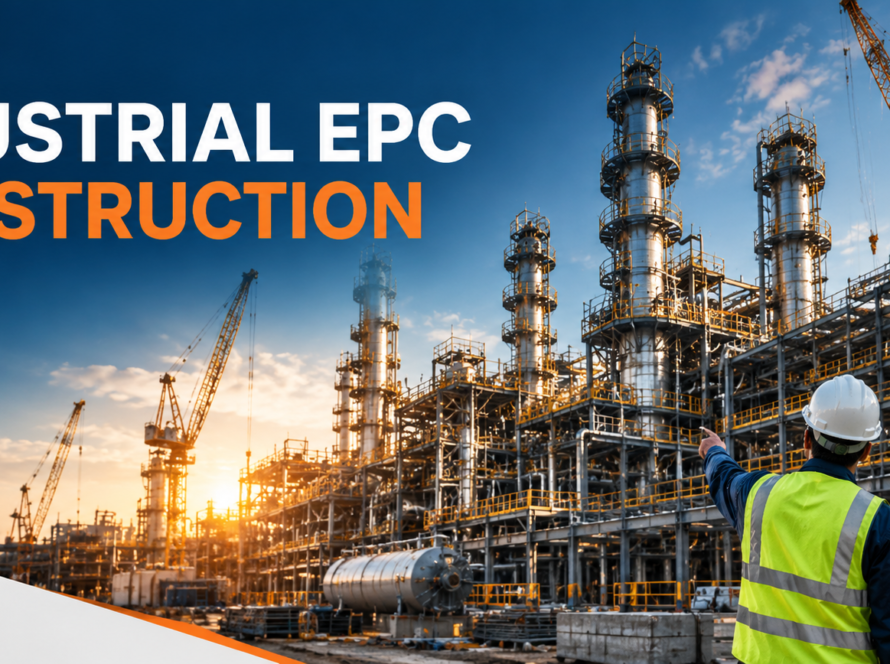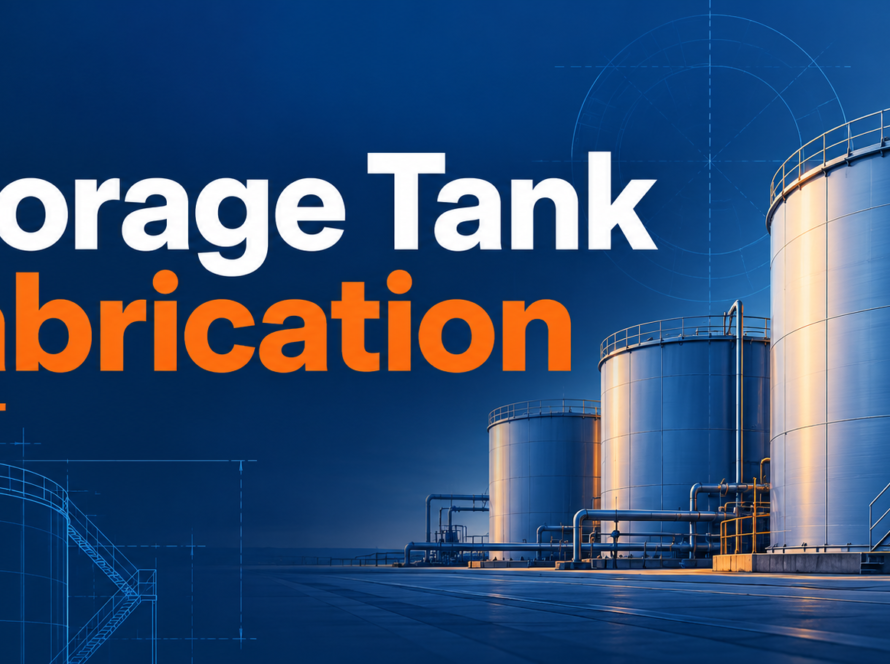

Storage tank erection is a critical stage in industrial tank construction because the quality of field assembly directly affects tank integrity, safety, and long-term performance. From workshop fabrication and foundation preparation to welding, inspection, testing, and final handover, every step must follow an approved engineering basis. IESCON supports industrial tank projects with coordinated fabrication, erection, piping, inspection, and project execution services.
What Is Storage Tank Erection?
Storage tank erection is the process of assembling and installing a fabricated storage tank at its final project location. Depending on the tank design, components may be fabricated in a workshop and transported to the site, while major shell courses, bottom plates, roof components, nozzles, stairways, and structural elements are assembled and welded in the field.
For large aboveground tanks, storage tank erection requires close coordination between:
- Civil and foundation works
- Steel fabrication
- Mechanical erection
- Welding
- Non-destructive testing (NDT)
- Quality control
- Crane and lifting operations
- Safety management
- Testing and commissioning
A successful erection project therefore starts before the first steel plate reaches the site.
What Are the Main Stages of Storage Tank Erection?
A typical storage tank erection project follows a controlled sequence:
- Engineering and approved construction drawings
- Workshop material preparation and fabrication
- Foundation inspection and site preparation
- Bottom plate installation
- Shell course erection
- Roof and structural installation
- Nozzles, manways, stairs, platforms, and accessories
- Welding and NDT
- Dimensional and alignment checks
- Tank testing
- Coating, lining, and final inspection where specified
- Commissioning and documentation
- Final handover
The exact sequence depends on tank diameter, roof configuration, erection methodology, project specifications, and applicable standards.
Storage Tank Erection Workflow
| Stage | Main Activity | Key Control |
| Engineering | Drawings and method statements | Approved design |
| Fabrication | Cutting, forming, and welding | Material traceability |
| Foundation | Level and condition verification | Survey inspection |
| Bottom | Plate installation and welding | Alignment and weld quality |
| Shell | Course-by-course erection | Plumbness and roundness |
| Roof | Structural and roof installation | Geometry and supports |
| Inspection | Visual and NDT | Approved inspection plan |
| Testing | Leak and integrity testing | Test procedure |
| Handover | Documentation and acceptance | Complete dossier |
Workshop Fabrication and Preparation
Workshop fabrication allows many components to be prepared under controlled conditions before being transported to the project site.
Typical activities include:
- Material receiving and identification
- Plate inspection
- Cutting and edge preparation
- Plate rolling
- Component forming
- Welding
- Dimensional inspection
- Nozzle and reinforcement fabrication
- Surface preparation
- Marking and identification
- Packing and transportation
Material traceability is particularly important. Each plate and fabricated component should be identifiable against the approved material documentation and project requirements.
Welding procedures and welder qualifications should also be established before production welding begins. API references related to tank inspection include welding processes, welding inspection, NDT, and welder qualifications.
Site Preparation and Foundation Requirements
A tank foundation provides the structural base for the complete tank. Any significant foundation problem can affect tank settlement, shell geometry, nozzle alignment, and bottom integrity.
Before storage tank erection begins, the contractor should verify:
- Foundation elevation
- Foundation diameter
- Levelness
- Anchor locations where applicable
- Concrete condition
- Drainage arrangements
- Foundation cleanliness
- Tank centerline
- Access for cranes and lifting equipment
Survey records should be documented before bottom plates are installed.
Practical Example
If the foundation elevation varies beyond the project tolerance, the shell may gradually lose its intended geometry during erection. Correcting the issue before steel assembly is generally easier than attempting to correct alignment after several shell courses have been installed.
This is why foundation inspection should be treated as a construction hold point rather than a routine formality.
Storage Tank Site Assembly and Erection Process
The field assembly sequence varies according to the tank design and approved erection method.
A typical field process includes:
1. Bottom Plate Installation
Bottom plates are positioned according to the approved tank layout. Temporary supports, plate overlaps, orientation, and weld preparation are checked before welding.
2. Shell Course Erection
Shell plates are assembled course by course. Each course must be checked for:
- Vertical alignment
- Roundness
- Elevation
- Joint fit-up
- Plate distortion
- Weld preparation
3. Roof Installation
Depending on the tank configuration, the roof may be fixed, floating, cone-shaped, dome-shaped, or another approved configuration.
Roof installation requires careful control of structural alignment and temporary supports.
4. Nozzles and Accessories
Nozzles, manways, reinforcement pads, stairways, platforms, ladders, vents, drains, and other accessories are installed according to approved drawings.
5. Final Dimensional Verification
Before testing, the completed tank should undergo dimensional checks to verify that construction remains within the specified tolerances.
Welding and Quality Control During Tank Erection
Welding is one of the most important quality-control activities during tank construction.
A strong welding control system normally includes:
- Approved Welding Procedure Specifications (WPS)
- Qualified welding personnel
- Controlled welding consumables
- Pre-welding fit-up inspection
- Welding parameter control
- Visual inspection
- Nondestructive test where required
- Repair procedures for rejected welds
- Weld mapping and documentation
Quality control should be integrated into the erection sequence rather than performed only after construction is complete.
API documentation identifies welding inspection, welding processes, welding procedures, welding materials, welder qualifications, and NDT as important inspection subjects for aboveground storage tank work.
Inspection and Testing of Storage Tanks
Inspection confirms that the tank has been constructed according to the approved design and applicable requirements.
Depending on the project, inspection may include:
- Visual inspection
- Dimensional inspection
- Weld inspection
- Radiographic testing (RT)
- Ultrasonic testing (UT)
- Magnetic particle testing (MT)
- Liquid penetrant testing (PT)
- Vacuum box testing
- Hydrostatic testing
- Leak testing
- Settlement monitoring
Not every tank requires every test. The inspection and test plan should define the required examinations based on the tank design, service, code, and project specification.
API’s current standards framework identifies API 650 for welded oil-storage tanks and API 653 for tank inspection, repair, alteration, and reconstruction.
API Standards and Requirements for Storage Tank Erection
API standards are an important part of many industrial storage tank projects.
API 650 addresses Welded Tanks for Oil Storage and covers applicable requirements associated with tank design, fabrication, erection, and inspection. API announced its 14th Edition in August 2025, with an API Monogram Program effective date of March 1, 2026.
Other API publications may apply depending on the project and tank service, including requirements and practices associated with:
- Tank inspection
- Welding
- Nondestructive test
- Cathodic protection
- Bottom protection
- Safe access
- Maintenance and mechanical integrity
API 653 is particularly associated with inspection, repair, alteration, and reconstruction of aboveground storage tanks.
The important point is that the contractor should identify the applicable edition and project requirements at the engineering stage rather than relying on a generic tank erection procedure.
Safety Requirements During Storage Tank Erection
Tank erection involves lifting, working at height, welding, temporary structures, confined spaces, and heavy components.
Key safety controls include:
- Approved lifting plans
- Crane inspection
- Rigging inspection
- Fall protection
- Hot-work controls
- Fire prevention
- Gas and atmospheric testing where required
- Confined-space procedures
- Electrical safety
- Lockout/tagout
- Emergency response planning
- Safe access and egress
- Daily toolbox meetings
OSHA identifies storage-tank work hazards including fire and explosion, asphyxiation, toxicity, falls, entrapment, electrical hazards, and exposure to hazardous vapors.
During construction, OSHA also specifically addresses confined-space hazards associated with aboveground tank erection.
Hot work requires particular attention because even apparently empty tanks or equipment may contain residues capable of producing flammable atmospheres.
Final Inspection, Commissioning, and Handover
The final stage confirms that the tank is ready for its intended service.
Before handover, the project team should verify:
- All construction activities are complete.
- Required inspections have been accepted.
- Testing has been completed successfully.
- Outstanding punch-list items are closed.
- Coating or lining requirements are completed.
- Accessories are installed and functional.
- Tank identification is complete.
- Cleaning is completed.
- Required documentation is compiled.
- Owner acceptance is obtained.
The final handover dossier may include:
- Approved drawings
- Material certificates
- Welding records
- Welder qualifications
- NDT reports
- Dimensional inspection reports
- Test records
- Coating reports
- Calibration certificates
- Inspection certificates
- As-built drawings
- Punch-list records
- Operation and maintenance documents
Good documentation is part of tank completion—not an administrative task added after construction.
Common Storage Tank Erection Challenges and How to Avoid Them
| Challenge | Possible Effect | Preventive Action |
| Poor foundation level | Shell distortion or alignment issues | Detailed pre-erection survey |
| Incorrect plate identification | Material traceability problems | Controlled marking system |
| Poor fit-up | Welding defects and rework | Fit-up inspection |
| Excessive welding distortion | Geometry problems | Controlled welding sequence |
| Poor lifting planning | Safety and schedule risks | Approved lifting plan |
| Weather interruptions | Schedule delays | Weather monitoring and contingency |
| Incomplete NDT | Delayed acceptance | Inspection tracking system |
| Poor documentation | Handover delays | Progressive dossier preparation |
| Uncontrolled site access | Safety incidents | Site access and permit controls |
Practical Project Example
Imagine a large tank where the foundation inspection is completed but the survey records show an unacceptable elevation variation.
A weak approach would be to continue erection and address the issue later.
A controlled approach is to stop the affected activity, review the deviation, obtain engineering disposition, correct the foundation if required, and only then proceed with bottom and shell installation.
This illustrates an important principle: early quality control can prevent expensive field rework.
How to Choose a Storage Tank Erection Contractor
Choosing a contractor should go beyond checking whether the company can physically assemble steel plates.
Evaluate:
- Relevant tank erection experience
- Engineering capability
- API-based project knowledge
- Welding qualifications
- NDT coordination
- Quality management system
- HSE performance
- Skilled workforce
- Lifting equipment
- Project planning capability
- Material traceability
- Documentation systems
- Testing and commissioning experience
- Ability to coordinate civil, mechanical, piping, and electrical interfaces
Ask the contractor to provide evidence of similar project experience, quality procedures, inspection plans, erection methodologies, and safety systems.
A technically capable contractor should be able to explain not only how the tank will be erected but also how quality, safety, schedule, and documentation will be controlled throughout the process.
Storage Tank Erection Checklist
Use the following checklist before awarding or starting a tank erection project:
Engineering
- Approved tank drawings
- Applicable codes identified
- Erection method approved
- Inspection and Test Plan approved
- Welding procedures approved
Fabrication
- Materials verified
- Material certificates available
- Plate dimensions checked
- Welding qualifications verified
- Components marked and traceable
Site
- Foundation inspected
- Survey completed
- Access prepared
- Crane locations confirmed
- Temporary facilities available
Erection
- Bottom plates installed
- Shell courses aligned
- Roof installed
- Nozzles and manways installed
- Platforms and ladders completed
Quality
- Visual inspections completed
- Required NDT completed
- Dimensional checks completed
- Testing completed
- Defects repaired and accepted
Handover
- Punch list closed
- As-built drawings completed
- Inspection dossier completed
- Test records approved
- Owner acceptance obtained
FAQs About Storage Tank Erection
1. What does storage tank erection include?
Storage tank erection includes site preparation, bottom and shell assembly, roof installation, welding, accessories, inspection, testing, finishing, commissioning, and final project handover.
2. How long does storage tank erection take?
The duration depends on tank diameter, capacity, design, fabrication status, erection method, site conditions, workforce, weather, inspection requirements, and project complexity.
3. Which standard is commonly used for welded storage tanks?
API 650 is widely used as a key standard for applicable welded aboveground oil-storage tanks. The applicable edition and project requirements should always be confirmed before execution.
4. What inspections are required during tank erection?
Inspections can include visual, dimensional, weld, NDT, leak, vacuum-box, hydrostatic, and settlement-related checks, depending on the approved inspection plan and tank design.
5. Why is contractor selection important for tank erection?
A qualified contractor coordinates fabrication, erection, welding, inspection, safety, testing, documentation, and interfaces between disciplines, reducing avoidable quality and schedule risks.
Conclusion
Successful storage tank erection depends on controlled fabrication, accurate site assembly, qualified welding, inspection, testing, and complete documentation. IESCON provides integrated industrial execution capabilities to help clients manage tank erection from workshop preparation through final handover, with project requirements, quality, safety, and applicable standards considered throughout the execution process.
Need Professional Storage Tank Erection Services?
Planning a new storage tank, tank farm, or industrial facility?
Contact IESCON today to discuss your project requirements and get professional support for tank fabrication, site erection, inspection, testing, and final handover.