


Heavy Steel Fabrication requires more than cutting and welding large steel sections. Oversized industrial components demand accurate engineering, suitable materials, controlled fabrication, qualified welding, dimensional inspection, safe handling, and careful transportation. IESCON supports industrial fabrication requirements with a structured approach that connects engineering drawings, fabrication, quality control, inspection, and project execution.
What Is Heavy Steel Fabrication?
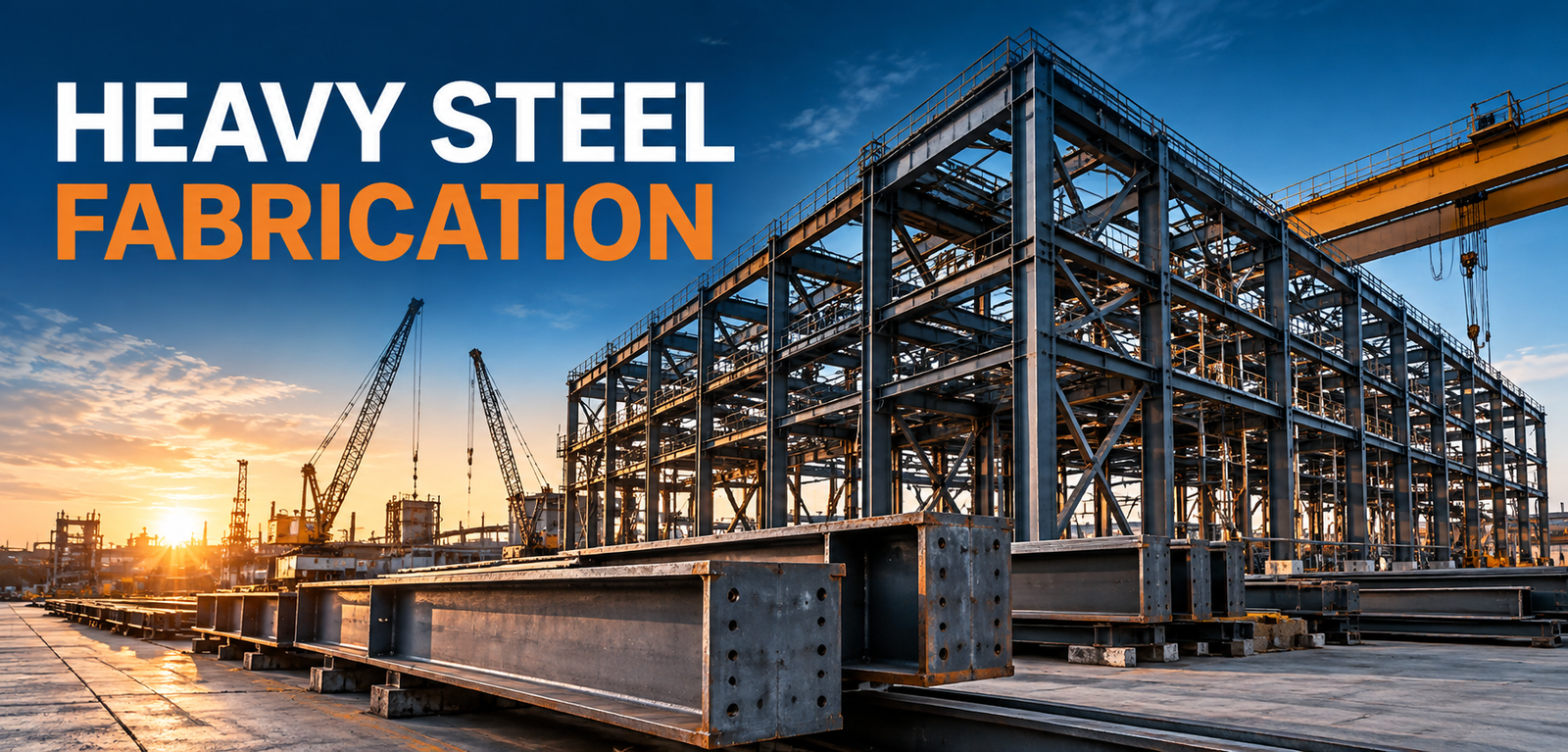
Heavy Steel Fabrication is the process of manufacturing large and heavy steel structures, assemblies, and industrial components according to approved engineering drawings and technical specifications.
Unlike standard steel fabrication, heavy fabrication often involves thick plates, large structural sections, complex welded assemblies, high lifting loads, and demanding dimensional requirements.
Typical applications include:
- Industrial equipment supports
- Large structural frames
- Heavy platforms and access structures
- Pressure vessel components
- Storage tank components
- Skids and process assemblies
- Large pipe-support structures
- Industrial platforms
- Machinery bases
- Heavy equipment structures
The fabrication process normally covers material receiving, cutting, forming, fit-up, welding, inspection, dimensional control, surface preparation, assembly, and preparation for transportation or site erection.
The applicable welding requirements depend on the component, material, loading condition, project specification, and governing code. For structural steel applications, AWS D1.1/D1.1M:2025-AMD1 establishes requirements covering structural steel welding, including design, fabrication, qualification, and inspection.
What Are Oversized Industrial Components?
Oversized industrial components are assemblies or fabricated steel items whose dimensions or weight create special requirements for manufacturing, lifting, handling, transportation, or installation.
An oversized component may be difficult to move through conventional transportation routes or may require special lifting equipment and a dedicated handling plan.
Examples include:
| Component | Typical Fabrication Concern |
| Large structural frame | Alignment and weld distortion |
| Heavy equipment base | Flatness and dimensional accuracy |
| Large tank section | Rolling, fit-up, and transportation |
| Process skid | Weight distribution and lifting points |
| Large platform | Structural stability and assembly |
| Heavy pipe rack section | Modular lifting and connection accuracy |
| Machinery support | Load transfer and foundation interface |
The important issue is not simply whether a component is physically large. Its weight, center of gravity, geometry, lifting points, transportation route, and installation method can all affect fabrication decisions.
Key Requirements for Heavy Steel Fabrication Projects
A successful heavy fabrication project should establish technical requirements before production begins.
The main requirements include:
- Approved engineering drawings.
- Clearly defined material specifications.
- Applicable fabrication and welding codes.
- Qualified welding procedures.
- Qualified welding personnel.
- Material traceability.
- Dimensional inspection requirements.
- NDT requirements where applicable.
- Lifting and handling requirements.
- Surface treatment specifications.
- Transportation limitations.
- Site installation requirements.
A major component should also be designed with its complete lifecycle in mind.
For example, a frame that is easy to fabricate but impossible to lift safely is not an effective fabrication solution. Similarly, a large assembly that cannot fit the transportation route may need to be divided into transportable modules.
Materials and Steel Specifications
Material selection directly affects fabrication quality, structural performance, welding procedures, and project cost.
Depending on the application, heavy steel fabrication may use:
- Carbon structural steel
- Low-alloy steel
- High-strength structural steel
- Stainless steel
- Wear-resistant steel
- Other project-specified steel grades
The material specification should identify properties such as:
- Grade
- Thickness
- Yield strength
- Tensile strength
- Impact requirements where applicable
- Chemical composition
- Heat-treatment requirements
- Welding requirements
Material Traceability
Every major steel component should remain traceable throughout fabrication.
A practical traceability process can follow:
Material delivery → Material certificate → Identification → Cutting → Component identification → Assembly → Welding records → Final inspection
This reduces the risk of losing material identification after cutting or forming.
Design, Engineering, and Fabrication Drawings
Engineering accuracy is one of the most important foundations of Heavy Steel Fabrication.
Fabrication drawings should provide enough information for the workshop team to manufacture the component without relying on assumptions.
Important drawing information includes:
- Overall dimensions
- Plate thicknesses
- Steel grades
- Weld symbols
- Weld sizes
- Connection details
- Hole locations
- Nozzle or pipe connections where applicable
- Lifting points
- Assembly references
- Tolerances
- Surface treatment requirements
- Weight information
For oversized components, drawings should also consider fabrication sequence and transportation requirements.
Practical Example
Consider a large equipment support frame that must be transported to an industrial site.
If the complete frame exceeds the available transportation envelope, the engineering team may divide it into several bolted or welded modules.
The fabrication drawing therefore needs to define not only the final structure but also the connection points, lifting locations, module dimensions, and site assembly sequence.
This is an illustrative project example rather than a claim about a specific completed IESCON project.
Cutting, Forming, and Welding in Heavy Steel Fabrication
The fabrication process generally starts with material preparation and continues through controlled assembly.
Step 1: Material Preparation
Steel plates and sections are inspected against the approved material requirements.
Step 2: Cutting
Plates and sections are cut according to fabrication drawings while maintaining required dimensions and traceability.
Step 3: Forming
Where required, plates are rolled, bent, or otherwise formed to the specified geometry.
Step 4: Fit-Up
Components are positioned and aligned before welding.
Step 5: Welding
Qualified procedures and personnel are used according to the applicable code and project specification.
Step 6: Weld Inspection
Welds are visually inspected and subjected to applicable NDT.
Step 7: Dimensional Verification
The completed assembly is checked against approved drawings and tolerances.
AWS D1.1/D1.1M covers welding requirements for welded structures made from commonly used carbon and low-alloy constructional steels, including fabrication and inspection requirements.
Dimensional Accuracy and Quality Control
Large steel components can experience dimensional changes during cutting, forming, welding, lifting, and cooling.
Welding heat can cause distortion, while inaccurate fit-up can affect the final geometry.
A dimensional quality-control program should therefore check:
- Overall length
- Width
- Height
- Diagonal measurements
- Straightness
- Flatness
- Squareness
- Hole locations
- Connection positions
- Elevations
- Interface dimensions
Why Dimensional Control Matters
Imagine a large fabricated base designed to connect to existing equipment.
If the final bolt locations are several millimeters away from the required positions, the problem may only become obvious during site installation.
Correcting that issue after transportation can be significantly more complicated than identifying it during workshop inspection.
For this reason, dimensional inspection should take place at important fabrication stages rather than only after final assembly.
Inspection and Testing Requirements
Inspection requirements depend on the component, material, loading conditions, applicable code, and project specification.
Possible inspection activities include:
| Inspection | Purpose |
| Material inspection | Verify material identity and condition |
| Visual inspection | Identify visible defects |
| Dimensional inspection | Confirm geometry |
| Weld inspection | Verify weld quality |
| Ultrasonic testing | Detect applicable internal discontinuities |
| Magnetic particle testing | Identify relevant surface or near-surface indications |
| Liquid penetrant testing | Detect surface-breaking indications |
| Coating inspection | Verify surface treatment |
| Final inspection | Confirm completion against requirements |
Not every fabrication project requires every NDT method. The inspection and test plan should define the applicable examination method, extent, acceptance criteria, and hold points.
Equipment and Facilities for Heavy Steel Fabrication
Heavy fabrication requires facilities capable of safely handling large and heavy components.
Important capabilities may include:
- Heavy-duty cranes
- Adequate lifting capacity
- Fabrication bays
- Welding equipment
- Plate-cutting equipment
- Forming and rolling equipment
- Assembly areas
- Dimensional inspection tools
- NDT access
- Material storage areas
- Suitable loading areas
What Should Be Checked?
Before awarding a heavy fabrication scope, the client should verify:
Workshop capacity: Can the facility accommodate the component’s dimensions?
Crane capacity: Can the available lifting equipment safely handle the component?
Floor capacity: Can the workshop support the weight during fabrication and assembly?
Access: Can the component enter and leave the facility?
Inspection capability: Can the required dimensional and NDT activities be performed?
Loading capability: Can the finished component be transferred safely to the transportation vehicle?
These questions are particularly important when dealing with oversized industrial components.
Welding Standards and Welder Qualifications
Welding requirements should be established before fabrication begins.
The project should identify:
- Applicable welding code
- Welding process
- Base material
- Filler material
- Joint configuration
- Welding position
- Preheat requirements
- Interpass temperature requirements
- Post-weld treatment where required
- Inspection requirements
- Welder qualification requirements
AWS identifies D1.1/D1.1M:2025 as its current Structural Welding Code for steel, covering design, fabrication, qualification, and inspection requirements for applicable welded steel structures.
The applicable code must always be selected based on the actual structure and contract requirements rather than assuming that one welding standard applies to every project.
Safety Requirements for Heavy Steel Fabrication
Heavy steel work combines several hazards, particularly during lifting, welding, cutting, assembly, and erection.
Safety planning should address:
- Crane and lifting operations
- Rigging
- Suspended loads
- Welding and hot work
- Electrical equipment
- Working at height
- Confined or restricted work areas
- Falling objects
- Material handling
- Fire prevention
- Personal protective equipment
- Emergency procedures
OSHA identifies steel erection as a high-hazard construction activity and provides requirements and guidance addressing steel erection operations.
Safe Lifting Principle
Before lifting a large component, the team should confirm:
- Component weight.
- Center of gravity.
- Lifting-point capacity.
- Rigging configuration.
- Crane capacity at the required radius.
- Ground conditions.
- Travel path.
- Communication method.
- Exclusion zone.
- Landing location.
A lifting plan should be prepared according to the actual component and site conditions.
Transportation and Handling of Oversized Components
Transportation should be considered during fabrication, not after the component is completed.
Key factors include:
- Overall dimensions
- Total weight
- Center of gravity
- Lifting points
- Trailer capacity
- Loading method
- Route restrictions
- Bridge and road limitations
- Clearance requirements
- Site access
- Unloading method
Fabrication vs. Transportation
| Approach | Main Advantage | Main Consideration |
| One-piece fabrication | Less site assembly | More demanding transport and lifting |
| Modular fabrication | Easier transportation | Requires accurate site assembly |
| Partial assembly | Balanced approach | Requires detailed planning |
The correct approach depends on the project route, available lifting equipment, site conditions, and final installation requirements.
How to Choose a Heavy Steel Fabrication Contractor
Choosing a Heavy Steel Fabrication Contractor should involve a technical review rather than price comparison alone.
Check:
- Fabrication capacity
- Workshop dimensions
- Crane capacity
- Material handling capability
- Welding qualifications
- Quality-control procedures
- NDT arrangements
- Dimensional inspection capability
- Engineering coordination
- HSE procedures
- Transportation planning
- Documentation system
- Experience with large industrial assemblies
A useful contractor evaluation should ask one fundamental question:
Can the contractor control the entire path from engineering drawings to fabrication, inspection, handling, and delivery?
Common Challenges in Heavy Steel Fabrication Projects
Welding Distortion
Large welds can introduce deformation. Proper sequencing, fit-up control, and inspection help manage dimensional changes.
Material Availability
Large or specialized steel sections may have longer procurement requirements.
Dimensional Errors
Small errors can become significant when multiple large components must connect together.
Lifting Constraints
A component may be within the workshop’s fabrication capability but exceed available crane or lifting capacity.
Transportation Restrictions
Road limitations can require modular fabrication instead of one-piece construction.
Late Engineering Changes
Changes after cutting or welding begins can result in rework and schedule impact.
Interface Problems
Fabricated components often connect to equipment, piping, foundations, or structures produced by other project scopes. Accurate interface information is therefore essential.
Heavy Steel Fabrication Inspection Checklist
Before releasing a fabricated oversized component, the project team can use the following checklist:
| Checkpoint | Status |
| Approved fabrication drawings | ☐ |
| Material certificates verified | ☐ |
| Material traceability maintained | ☐ |
| Cutting dimensions checked | ☐ |
| Forming dimensions checked | ☐ |
| Fit-up inspected | ☐ |
| Welding procedures approved | ☐ |
| Welder qualifications verified | ☐ |
| Welds visually inspected | ☐ |
| Required NDT completed | ☐ |
| Dimensional inspection completed | ☐ |
| Lifting points verified | ☐ |
| Weight confirmed | ☐ |
| Surface treatment completed | ☐ |
| Final documentation completed | ☐ |
| Transportation plan reviewed | ☐ |
This checklist should be adapted to the applicable project specification, inspection and test plan, and governing codes.
Frequently Asked Questions About Heavy Steel Fabrication
1. What does Heavy Steel Fabrication include?
Heavy Steel Fabrication includes engineering coordination, material preparation, cutting, forming, fit-up, welding, inspection, dimensional control, assembly, surface treatment, and preparation for transportation or installation.
2. What steel is used in heavy fabrication?
The steel grade depends on structural requirements, loading, environment, temperature, weldability, applicable standards, and project specifications. Carbon and low-alloy structural steels are common choices for many applications.
3. How is quality controlled during heavy steel fabrication?
Quality is controlled through material traceability, approved drawings, welding procedures, qualified personnel, dimensional inspections, visual examination, applicable NDT, and final documentation.
4. What is the biggest challenge with oversized steel components?
Oversized components require coordination between fabrication, lifting, transportation, and installation. A design that works in the workshop may still require modification if its weight or dimensions exceed available handling or transportation limits.
5. How do I choose a Heavy Steel Fabrication Contractor?
Review the contractor’s workshop capacity, lifting equipment, welding qualifications, quality system, inspection capabilities, engineering coordination, safety procedures, handling capability, and ability to provide complete project documentation.
Conclusion
Successful Heavy Steel Fabrication depends on controlling engineering, materials, welding, dimensions, inspection, lifting, and transportation as one connected process. IESCON can support industrial fabrication requirements with an approach focused on technical coordination, fabrication quality, inspection, and safe project execution from approved drawings to finished components.
Need Heavy Steel Fabrication for Your Industrial Project?
Planning a large steel structure, industrial assembly, or oversized component? Start with the right engineering and fabrication approach.
Contact IESCON today to discuss your project requirements and get professional support for heavy steel fabrication, inspection, and industrial execution.