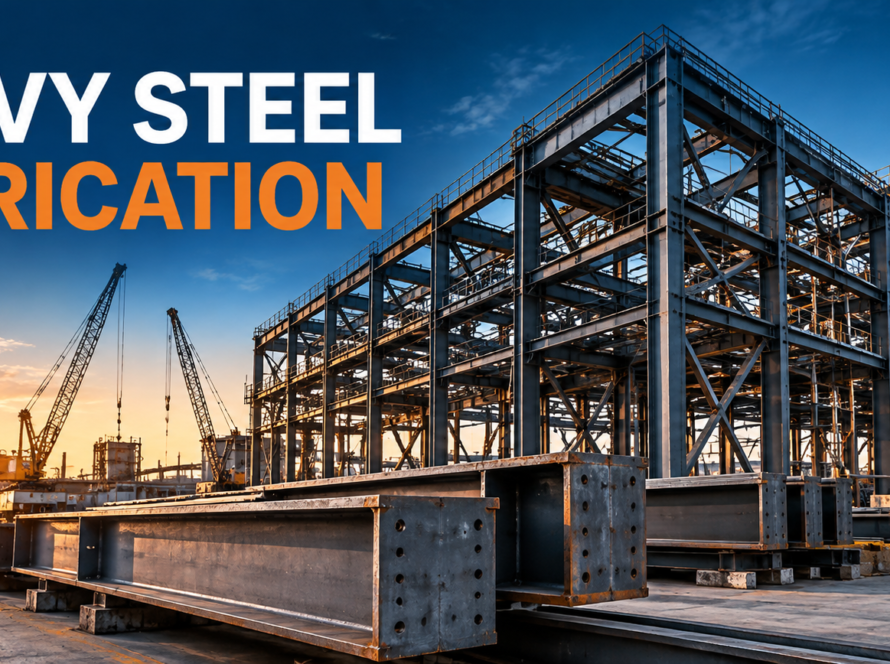



Local fabrication can give industrial projects greater control over customization, communication, and delivery, while imported components may be required for specialized equipment or proprietary specifications. IESCON helps project teams evaluate fabrication requirements based on technical specifications, quality, schedule, logistics, and project interfaces before deciding how components should be sourced.
What Is Local Fabrication?
Local fabrication is the manufacturing or assembly of industrial components within Egypt using locally available materials, equipment, engineering resources, and fabrication facilities.
For industrial projects, local fabrication may cover:
- Steel structures
- Storage tank components
- Pipe supports
- Platforms and walkways
- Industrial skids
- Equipment bases
- Piping assemblies
- Heavy steel components
- Custom-fabricated supports
- Maintenance and replacement components
The exact scope depends on the project’s engineering requirements and the capabilities of the selected fabricator.
Local fabrication does not necessarily mean that every material or component must originate in Egypt. A locally fabricated assembly may still use imported steel grades, valves, instruments, fittings, or specialized components when required by the project specification.
This distinction is important when evaluating local fabrication vs imported components.
Local Fabrication vs. Imported Components: Key Differences
The decision should be based on the complete project requirement rather than the purchase price of the component alone.
| Factor | Local Fabrication | Imported Components |
| Customization | Usually easier for project-specific modifications | May be limited by manufacturer’s standard design |
| Communication | Direct local coordination | May involve international coordination |
| Lead time | Can be shorter for suitable local capacity | Includes manufacturing and international shipping |
| Transportation | Primarily domestic | International freight plus local delivery |
| Customs | No import clearance for locally fabricated scope | Customs and import procedures apply |
| Technical support | Local coordination may be easier | Depends on supplier and local representation |
| Specialized technology | Depends on local capability | Can provide access to specialized products |
| Replacement | Local rework may be easier | Replacement may require another international order |
| Documentation | Based on project requirements | Supplier documentation may follow foreign manufacturing systems |
| Currency exposure | Often lower foreign-currency exposure | May involve foreign currency and freight costs |
Neither option is automatically suitable for every project.
The correct choice depends on the component’s technical complexity, availability, certification requirements, schedule, total delivered cost, and long-term maintenance needs.
When Is Local Fabrication the Better Option?
Local fabrication can be considered when the project requires customized components, close engineering coordination, short delivery distances, or modifications during execution.
It can be particularly useful for:
Customized Steelwork
Structures that must match specific site dimensions may benefit from local measurement, fabrication, and adjustment.
Large Fabricated Assemblies
Large components may be more practical to fabricate closer to the final installation site when transportation dimensions and lifting requirements are significant.
Replacement Components
When an existing industrial component requires replacement or modification, local fabrication can allow the engineering team to work directly with the actual site dimensions.
Time-Sensitive Work
If the required fabrication capability and materials are available locally, the project team may reduce international shipping time.
However, local availability should never replace technical qualification. The fabricator must still demonstrate that it can meet the required design, welding, inspection, material, and documentation requirements.
When Should Project Teams Consider Imported Components?
Imported components may be appropriate when the project requires:
- Proprietary equipment
- Specialized materials
- Components unavailable from qualified local sources
- Original equipment manufacturer specifications
- Specialized instrumentation
- Specific international certifications
- Highly specialized manufacturing technology
- Components already standardized by the equipment supplier
For example, a project may use local fabrication for the supporting steel structure while importing a specialized process component that must comply with the original equipment manufacturer’s specification.
This hybrid model can sometimes combine local manufacturing with specialized international supply.
Cost Comparison: Local Fabrication vs. Imports in Egypt
Comparing the supplier’s quoted price alone can produce a misleading result.
A proper cost comparison should calculate total delivered and installed cost.
Local Fabrication Cost
A local fabrication estimate may include:
- Raw materials
- Cutting and forming
- Welding
- Machining where required
- NDT
- Surface preparation
- Coating
- Assembly
- Local transportation
- Site installation
Imported Component Cost
An imported component may involve:
- Product purchase price
- International freight
- Marine or air transportation
- Insurance
- Customs-related costs
- Port and handling charges
- Customs clearance
- Inland transportation
- Storage
- Installation
- Potential inspection or certification costs
Therefore:
Total Project Cost = Purchase/Fabrication Cost + Logistics + Inspection + Installation + Associated Project Costs
Example
Suppose an industrial project needs a large fabricated steel support.
A local fabricator quotes a higher manufacturing price than an overseas supplier. At first glance, importing appears cheaper.
However, after adding international freight, customs-related costs, port handling, inland transportation, inspection, and additional lead time, the difference may change.
This is why project teams should compare total landed cost, not simply the initial quotation.
Actual customs duties and taxes depend on the product classification, origin, applicable regulations, and shipment details, so they should be confirmed for the specific item before making a commercial decision.
Quality and Technical Standards
Quality should be evaluated using measurable technical requirements rather than geographic origin.
For local fabrication, the project team should verify:
- Material specifications
- Material certificates
- Welding procedures
- Welder qualifications
- Dimensional tolerances
- NDT requirements
- Inspection and Test Plan
- Surface preparation
- Coating requirements
- Calibration records
- Final documentation
For imported components, the same principle applies, with additional attention to the manufacturer’s quality system and required certificates.
Egypt’s Egyptian Organization for Standards & Quality (EOS) is the national body responsible for activities including Egyptian standards, quality assurance, conformity assessment, testing, and industrial measurements. Its official platform provides access to Egyptian standards and related services.
The project specification should determine which standards and acceptance criteria apply.
Lead Times, Delivery, and Project Scheduling
Lead time is one of the most important factors when comparing local fabrication and imports.
A useful project schedule should separate:
Engineering → Procurement → Fabrication → Inspection → Transportation → Site Delivery → Installation
For local fabrication, some of these stages can be coordinated within Egypt.
For imports, the schedule may also include:
Supplier Manufacturing → Export Documentation → Pre-Shipment Requirements → International Transportation → Customs/Port Procedures → Inland Transportation → Site Delivery
This creates additional interfaces that must be planned.
Schedule Comparison
| Schedule Factor | Local Fabrication | Imported Components |
| Engineering coordination | Local interface | International interface |
| Fabrication | Domestic | Overseas |
| Freight | Domestic | International + domestic |
| Customs | Generally not applicable to local manufacturing | Applicable according to import requirements |
| Delivery flexibility | Potentially higher | Depends on shipping schedule |
| Modification after production | May be easier to coordinate locally | Can be difficult and costly |
These are planning considerations rather than universal outcomes. Actual lead times depend on the specific project and supplier.
Material Availability and Supply Chain Considerations
Material availability can influence the decision significantly.
Before selecting local fabrication, confirm whether the required:
- Steel grade
- Plate thickness
- Sections
- Pipes
- Flanges
- Fittings
- Welding consumables
- Coating systems
- Specialized components
are available within the required project schedule.
If a critical material must be imported for local fabrication, the project team should include that procurement step in the schedule.
This leads to an important principle:
Local fabrication does not always mean a completely local supply chain.
The fabrication location and material origin are separate procurement decisions.
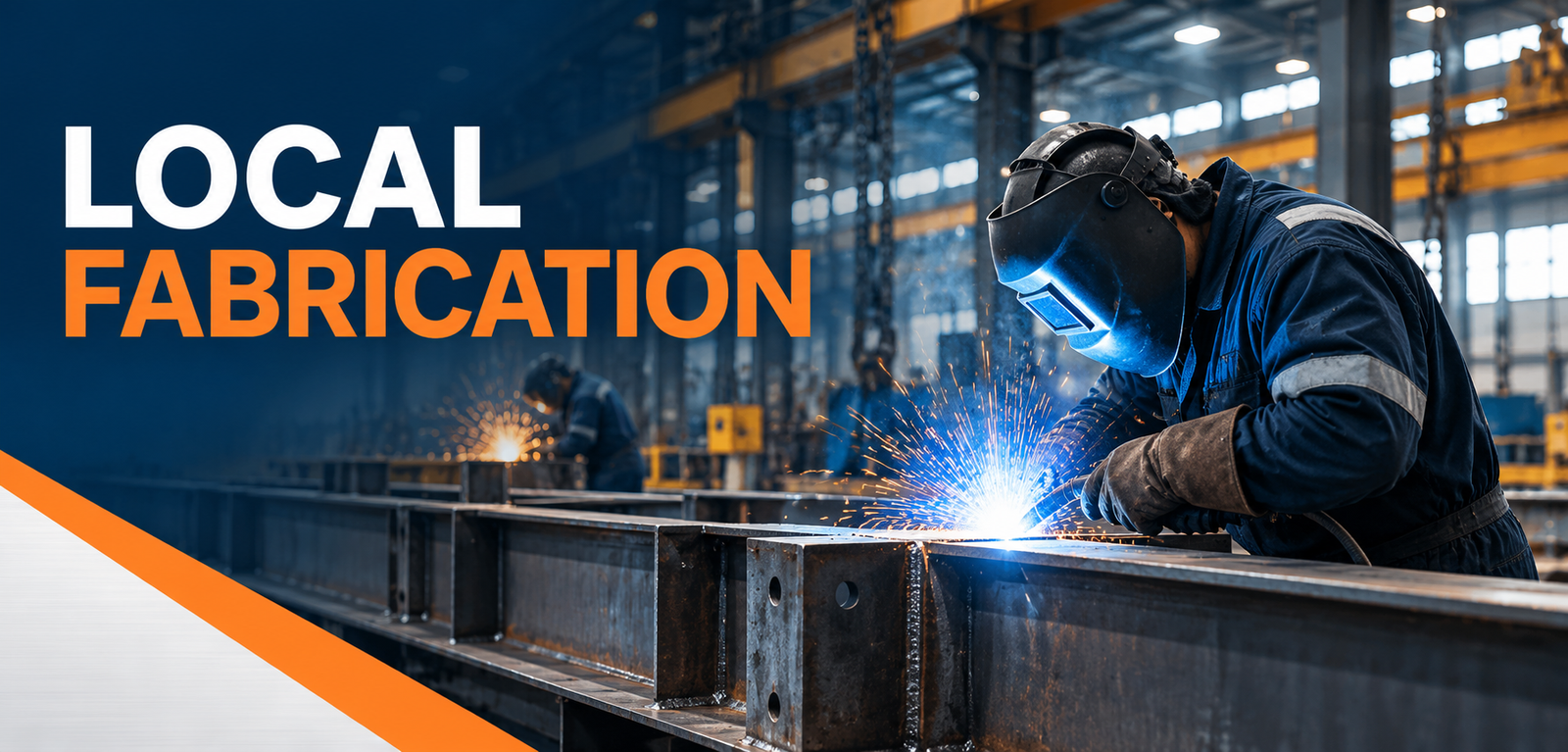
Customization and Engineering Requirements
Customization is often an important reason to evaluate local manufacturing.
A project may require a component to match:
- Existing equipment
- Existing foundations
- Site dimensions
- Existing pipe routes
- Existing structural connections
- Specific nozzle locations
- Special access requirements
A local fabrication team can potentially coordinate directly with the site team during measurement, engineering clarification, and fabrication.
Practical Example
An existing industrial facility requires a replacement steel platform around operating equipment.
The new platform must match existing support locations and available access space.
Instead of selecting a standard imported platform, the project team can develop fabrication drawings around the actual site dimensions.
The final decision should still be based on technical compliance, cost, schedule, and quality requirements.
Inspection, Testing, and Certification
Whether a component is fabricated locally or imported, inspection requirements should be defined before procurement.
A project inspection plan may cover:
- Material verification
- Dimensional inspection
- Fit-up inspection
- Welding inspection
- NDT
- Pressure or functional testing where applicable
- Surface preparation
- Coating inspection
- Final dimensional inspection
- Documentation review
For imported components, the project team should also confirm what inspection will take place before shipment and what will be inspected after arrival.
For local fabrication, inspection can potentially be integrated into the fabrication sequence.
The key question is not simply:
“Where was it manufactured?”
The better question is:
“Can the complete inspection and certification requirements be demonstrated?”
Logistics, Customs, and Import Considerations in Egypt
Imported components require additional planning around Egypt’s import procedures and logistics chain.
The Nafeza platform provides Egypt’s unified registration and electronic trade services. Its Advance Cargo Information system includes the issuance and verification of an ACID number for import shipments.
Nafeza’s official guidance shows that shipment information can include importer and foreign-exporter data, cargo details, customs classification, quantities, weights, bill-of-lading information, and invoice data.
For this reason, an import decision should consider more than the supplier’s factory price.
Project teams should verify:
- Product classification
- Required import documentation
- ACID/ACI requirements where applicable
- Shipping documents
- Commercial invoice
- Packing information
- Country of origin
- Customs procedures
- Port handling
- Customs clearance
- Inland transportation
- Required inspections or approvals
Import requirements can change and may vary by product category, so the specific shipment should be checked through the applicable Egyptian authorities and customs process before ordering.
How to Choose Between Local Fabrication and Imported Components
A structured decision process can make the comparison easier.
Step 1: Define the Technical Requirement
Specify dimensions, materials, codes, tolerances, testing, certification, and service conditions.
Step 2: Identify Qualified Sources
Determine which local fabricators and international suppliers can meet the technical requirements.
Step 3: Compare Total Cost
Include fabrication or purchase cost, logistics, inspection, customs where applicable, installation, and potential modification costs.
Step 4: Compare Lead Time
Calculate the complete timeline from purchase order to site delivery.
Step 5: Evaluate Quality Controls
Review WPS/PQR, welder qualifications, NDT capability, inspection plans, material traceability, and documentation.
Step 6: Evaluate Logistics
Consider dimensions, weight, transportation route, lifting requirements, customs, and site access.
Step 7: Review Lifecycle Requirements
Consider maintenance, replacement, spare parts, future modifications, and technical support.
Step 8: Document the Decision
Record the technical and commercial reasons behind the selected sourcing strategy.
Local Fabrication vs. Imported Components: Project Decision Checklist
| Decision Factor | Key Question |
| Technical compliance | Can the source meet every specification? |
| Material | Are the required grades available? |
| Quality | Is inspection properly controlled? |
| Certification | Are required certificates available? |
| Cost | What is the total delivered cost? |
| Lead time | When will the component reach the site? |
| Customization | Are project-specific modifications required? |
| Logistics | Can the component be transported safely? |
| Customs | Are import procedures required? |
| Installation | Does the component match site interfaces? |
| Maintenance | Can future support and replacement be managed? |
| Risk | Which supply-chain risks need mitigation? |
The result should be based on the project’s documented requirements rather than assuming that local or imported sourcing is always preferable.
Frequently Asked Questions About Local Fabrication in Egypt
1. What is local fabrication in Egypt?
Local fabrication is the manufacturing or assembly of industrial components within Egypt. It can include steel structures, tank components, pipe supports, platforms, skids, and other project-specific fabricated items.
2. Is local fabrication cheaper than importing?
Not necessarily. The correct comparison should include material, fabrication, transportation, inspection, customs-related costs, installation, and schedule impacts to determine the total project cost.
3. Can locally fabricated components meet international standards?
Yes, when the selected fabricator has the required technical capabilities, qualified personnel, approved procedures, inspection systems, materials, and applicable certifications to meet the project’s specified standards.
4. What are the main advantages of local fabrication?
Potential advantages include easier project coordination, customization, local site support, domestic transportation, and reduced dependence on international shipping for suitable components.
5. When should an Egyptian project import a component?
Importing may be considered when the required component is highly specialized, proprietary, unavailable from qualified local sources, or subject to a specific manufacturer’s or technology provider’s requirements.
Conclusion
The decision between local fabrication and imported components should be based on technical compliance, total cost, lead time, quality, logistics, customization, and lifecycle requirements. IESCON supports industrial project teams with fabrication and engineering coordination designed around actual project requirements, helping clients evaluate the right approach before production and installation begin.
Need Reliable Industrial Fabrication in Egypt?
Whether your project requires custom steelwork, tank components, pipe supports, or other industrial fabrication, the right sourcing decision starts with a clear technical assessment.
Contact IESCON today to discuss your project requirements and explore a practical local fabrication solution for your industrial facility.