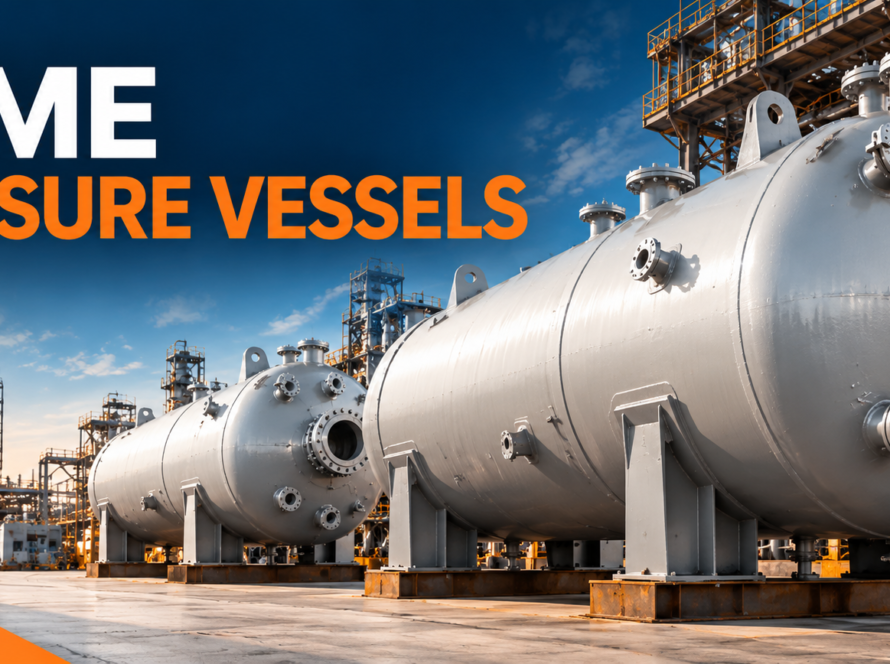


When preparing an RFQ for ASME pressure vessel fabrication, buyers need more than vessel dimensions and a target price. A clear RFQ should define design conditions, materials, applicable ASME codes, welding, inspection, testing, documentation, and delivery requirements. For industrial projects, IESCON helps project teams organize these technical requirements into a clear fabrication scope.
What Is an RFQ for ASME Pressure Vessel Fabrication?
An RFQ, or Request for Quotation, is a technical and commercial document used to request fabrication offers from qualified pressure vessel manufacturers.
An RFQ for ASME pressure vessel fabrication should give suppliers enough information to understand exactly what must be designed, manufactured, inspected, tested, documented, and delivered.
A strong RFQ reduces assumptions between the buyer and fabricator. It also makes quotations easier to compare because suppliers are responding to the same technical requirements.
For pressure vessels, the RFQ should normally address:
- Vessel type and service
- Design pressure and temperature
- Operating conditions
- Dimensions and capacity
- Materials
- Corrosion allowance
- Nozzles and connections
- Applicable ASME code and edition
- Welding requirements
- Inspection and NDT
- Testing requirements
- Documentation
- Certification
- Delivery requirements
ASME identifies BPVC Section VIII as the code covering pressure vessel construction, while its certification requirements for U and U2 designators reference applicable sections covering materials, Non-destructive test, pressure vessel construction, and welding qualifications.
What Information Should an RFQ for ASME Pressure Vessel Include?
A complete RFQ should be structured so that engineering, procurement, quality, and fabrication teams can review the same requirements.
| RFQ Section | Key Information |
| General data | Vessel name, service, quantity, location |
| Design | Pressure, temperature, volume, dimensions |
| Process | Fluid, density, composition, operating conditions |
| Materials | Shell, heads, nozzles, supports, internals |
| Codes | ASME Section VIII and applicable standards |
| Fabrication | Welding, forming, machining, assembly |
| Inspection | VT, RT, UT, MT, PT as applicable |
| Testing | Hydrostatic or other specified tests |
| Documentation | Drawings, certificates, reports, data book |
| Delivery | Schedule, packaging, transportation, installation |
The more complete the RFQ, the less room there is for different suppliers to interpret the scope differently.
Pressure Vessel Design and Technical Specifications
Design information is one of the most important parts of the RFQ.
The buyer should provide the available design basis, including:
- Design pressure
- Operating pressure
- Design temperature
- Operating temperature
- Vessel capacity
- Internal or external pressure requirements
- Vessel orientation
- Inside or outside diameter
- Tangent-to-tangent length
- Corrosion allowance
- Design life
- Vacuum requirements
- Wind and seismic requirements where applicable
- Support arrangement
- Nozzle schedule
- Internal components
The RFQ should also identify the process fluid and relevant properties. For example, a vessel handling corrosive chemicals may require a different material or corrosion allowance from a vessel handling a relatively non-corrosive service.
If engineering calculations are included in the RFQ, identify which documents are issued for construction and which are provided only as reference.
Materials and Material Specifications
Material selection directly affects vessel integrity, fabrication, cost, and delivery.
The RFQ should specify the required material grades where they are already established. It should also identify material requirements for:
- Shell plates
- Heads
- Nozzles
- Flanges
- Pipes
- Supports
- Internal components
- Reinforcement pads
- Bolting
- Welding consumables
Material requirements should include applicable specifications, thickness, testing requirements, traceability, and certificates.
Where the material grade has not yet been finalized, the RFQ should clearly state who is responsible for material selection and approval.
A strong procurement specification also prevents substitutions without written engineering approval.
ASME Codes and Applicable Standards
The RFQ must clearly state which ASME code and division apply.
For many pressure vessel projects, ASME BPVC Section VIII is central to the construction requirements. Depending on the project scope, additional sections may apply.
ASME’s official certification information identifies Section VIII Division 1 for U certification and Section VIII Division 2 for U2 certification. The required code framework also references Section II for materials, Section V for Non-destructive test, and Section IX for welding qualifications.
The RFQ should therefore identify:
- ASME BPVC Section VIII division
- Applicable edition or contractual code edition
- Material specifications
- NDT requirements
- Welding qualification requirements
- Applicable project standards
- Client specifications
- Local regulatory requirements
- Additional engineering standards
Do not simply write “ASME compliant.” State the exact code basis and applicable project requirements.
Fabrication, Welding, and Inspection Requirements
Fabrication requirements should explain how the pressure vessel is expected to be manufactured and controlled.
The RFQ can specify requirements for:
- Plate cutting and preparation
- Rolling or forming
- Fit-up
- Welding
- Heat treatment where required
- Nozzle installation
- Dimensional inspection
- Surface preparation
- Coating or lining
- Final inspection
Welding requirements are especially important. The RFQ should define the required welding procedures, welder qualifications, consumables, preheating, post-weld heat treatment where applicable, and inspection requirements.
ASME Section IX addresses qualification of welding procedures and personnel, including WPS and PQR-related requirements and welder performance qualification.
Example
If a vessel requires full-penetration welds with specified NDT coverage, that requirement should appear clearly in the RFQ rather than being left for the fabricator to interpret.
Testing and Quality Control Requirements
Testing requirements should be defined before quotations are received.
Depending on the vessel and applicable code, the RFQ may include:
- Visual examination
- Radiographic examination
- Ultrasonic examination
- Magnetic particle examination
- Liquid penetrant examination
- Dimensional inspection
- Hydrostatic testing
- Leak testing
- Pressure testing
- Functional checks for supplied components
ASME’s certification framework identifies BPVC Section V for Non-destructive test within the relevant pressure-vessel certification packages.
The RFQ should also clarify who performs inspections, whether a third-party inspector is required, what inspection points require client notification, and what records must be submitted.
Required Documentation and ASME Certification
Documentation should be treated as part of the fabrication scope—not as an afterthought.
A pressure vessel RFQ may require:
- General arrangement drawings
- Fabrication drawings
- Design calculations
- Material certificates
- Material traceability records
- WPS and PQR documentation
- Welder qualification records
- NDT reports
- Heat treatment records
- Dimensional inspection reports
- Pressure test reports
- Coating reports
- Calibration certificates
- Nonconformance reports
- Final inspection records
- As-built drawings
- Manufacturer’s data book
- ASME certification documents where applicable
For U and U2 pressure-vessel certifications, ASME specifies the applicable code books and certification framework based on the scope of certification.
The buyer should state exactly which documents are required with the quotation and which are required before final payment or shipment.
Delivery, Installation, and Project Requirements
An RFQ should not stop at fabrication.
The supplier should understand:
- Required manufacturing schedule
- Inspection dates
- Delivery location
- Packaging requirements
- Transportation limitations
- Maximum shipping dimensions
- Lifting requirements
- Site access restrictions
- Installation responsibility
- Site assembly requirements
- Commissioning support
- Warranty requirements
For large pressure vessels, transportation can affect vessel dimensions, lifting arrangements, route planning, and delivery sequence.
Therefore, delivery requirements should be considered during quotation preparation rather than after fabrication has started.
How to Compare ASME Pressure Vessel Fabrication Quotes
Comparing quotations only by price can create problems when suppliers have interpreted the RFQ differently.
Use a technical-commercial comparison matrix.
| Evaluation Area | Supplier A | Supplier B | Supplier C |
| Technical compliance | Review | Review | Review |
| ASME certification | Verify | Verify | Verify |
| Material compliance | Verify | Verify | Verify |
| Welding scope | Compare | Compare | Compare |
| NDT scope | Compare | Compare | Compare |
| Testing | Compare | Compare | Compare |
| Documentation | Compare | Compare | Compare |
| Delivery schedule | Compare | Compare | Compare |
| Exclusions | Review | Review | Review |
| Price | Compare | Compare | Compare |
A Practical Quote Review Process
Step 1: Check technical compliance
Confirm that each quotation addresses the complete technical specification.
Step 2: Review deviations
Identify substitutions, exclusions, alternative materials, or changes to inspection requirements.
Step 3: Compare documentation
Make sure the same documentation and certification scope are included.
Step 4: Compare schedule
Review engineering, procurement, fabrication, inspection, testing, and delivery milestones.
Step 5: Normalize commercial offers
Add excluded items or optional requirements before comparing total costs.
Step 6: Clarify open points
Send technical clarification questions before final supplier selection.
Illustrative Example
Suppose two suppliers submit quotations for the same vessel. Supplier A offers a lower price but excludes certain NDT activities and final documentation. Supplier B includes the complete inspection and documentation package.
The correct comparison is not simply the two headline prices. The buyer should first normalize both quotations against the original RFQ scope.
This is an illustrative procurement example, not a reported IESCON project case study.
Common RFQ Mistakes to Avoid
Several mistakes can make a pressure vessel RFQ difficult to price accurately.
1. Providing only vessel dimensions
Diameter and length are not enough to define the fabrication scope.
2. Omitting design conditions
Pressure and temperature are fundamental to pressure vessel design.
3. Writing “ASME compliant” without details
The RFQ should identify the applicable ASME section, division, edition, and project requirements.
4. Leaving material requirements unclear
Unclear materials can produce major differences in price and lead time.
5. Omitting inspection requirements
Suppliers may include different inspection scopes unless the RFQ defines them.
6. Ignoring documentation
A vessel can be physically complete while its documentation package remains incomplete.
7. Failing to identify exclusions
Unclear exclusions create commercial disputes during execution.
8. Comparing quotations without technical normalization
The cheapest initial quotation may not represent the same scope as another offer.
RFQ Checklist for ASME Pressure Vessel Fabrication
Before issuing the RFQ, confirm the following:
- Vessel service is defined
- Quantity is specified
- Design pressure is available
- Operating pressure is available
- Design temperature is defined
- Operating temperature is defined
- Vessel dimensions are provided
- Capacity is specified
- Corrosion allowance is defined
- Materials are specified
- Nozzle schedule is included
- Supports are defined
- Internal components are identified
- ASME code and division are stated
- Welding requirements are defined
- NDT requirements are defined
- Testing requirements are specified
- Documentation requirements are listed
- ASME certification requirements are clear
- Delivery location is stated
- Required delivery date is stated
- Installation responsibilities are defined
- Commercial exclusions are requested
- Deviations are clearly identified
A complete checklist makes it easier for procurement and engineering teams to issue consistent RFQs and evaluate returned offers on the same technical basis.
FAQs About RFQ for ASME Pressure Vessel Fabrication
What should an RFQ for ASME pressure vessel fabrication include?
It should include design conditions, vessel dimensions, materials, applicable ASME codes, welding requirements, inspection and testing, documentation, certification, delivery requirements, and commercial conditions.
Which ASME code is commonly used for pressure vessel fabrication?
ASME BPVC Section VIII is the primary pressure vessel construction code family. The applicable division should be identified according to the vessel design and project requirements.
Should an RFQ specify welding requirements?
Yes. The RFQ should define applicable welding procedures, qualification requirements, inspection, consumables, and any required heat treatment. ASME Section IX addresses welding procedure and personnel qualification.
What documents should be requested from a pressure vessel fabricator?
Typical documents include drawings, calculations, material certificates, traceability records, WPS/PQR records, welder qualifications, NDT reports, test reports, inspection records, as-built drawings, and the final manufacturer’s data book.
How can buyers compare pressure vessel fabrication quotations?
Compare quotations against the same technical scope first. Review deviations, materials, ASME certification, inspection, testing, documentation, schedule, exclusions, and normalized total cost before making a commercial comparison.
Conclusion
A well-prepared RFQ for ASME pressure vessel fabrication gives engineering and procurement teams a clear basis for receiving accurate, comparable quotations. IESCON can support industrial project requirements by structuring pressure vessel fabrication scopes around design, materials, ASME requirements, fabrication, inspection, testing, documentation, and delivery.
Need a Clear Pressure Vessel Fabrication Scope?
Planning an ASME pressure vessel project? Contact IESCON to discuss your fabrication requirements and develop a clear technical scope for your project.
Define the requirements. Control the fabrication scope. Build with confidence.